Category: Blog

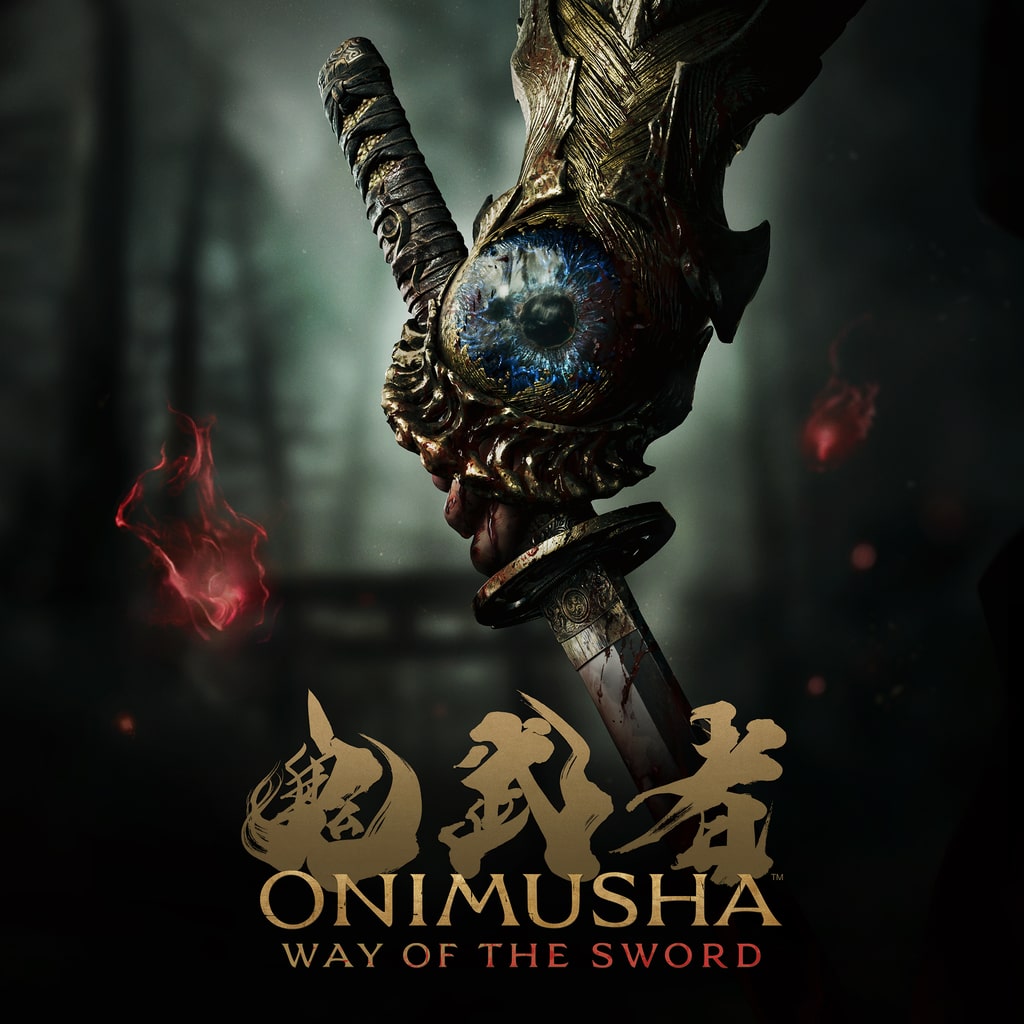
  • I Didn’t Hate Onimusha Way of the Sword But I Didn’t Love It Either

    I Didn’t Hate Onimusha Way of the Sword But I Didn’t Love It Either

    (This blog contains spoilers for Onimusha: Way of the Sword)

    When the PS2 released in the US, it felt like a huge magical leap. That in a short number of years we went from blocky polygons to amazingly rendered models and backgrounds felt like a dream. In truth it’s probably the hugest technological leap in the history of video games, between both storage increase and graphic fidelity.

    My older brother had decided he was going to go and get one. He was a lot older than me, and he had a job and I think he’d already graduated from high school at this point, but that part of the memory is foggy. Regardless, I’d been looking at a lot of games in a magazine, seeing what cool new stuff was being released for this insane system. One game in particular caught my eye: Onimusha.

    I’d been playing a lot of turn-based RPG’s at this point in my life and I really wanted to try an action RPG. Onimusha is…not really an RPG, but I hadn’t really realized that. My brother announced he was going to go buy one and I was ecstatic. I went up to him and, in the selfish way of a young child at age 11 or 12, told him, “You gotta get Onimusha with it!” He did that typical dismissive nod and went. I waited and waited and, after getting out of the shower, found he had come back. I checked to see what game he bought and…

    He had bought Gran Turismo 3: A-Spec.
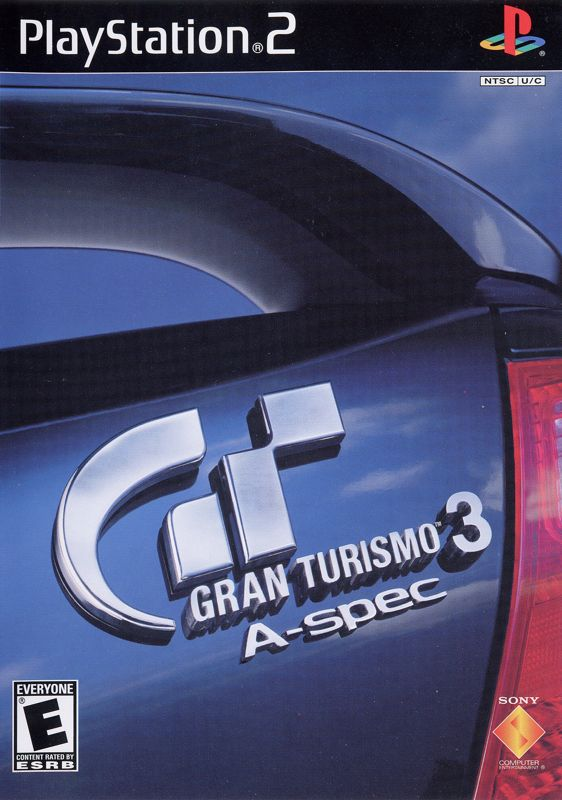
    Betrayed by a racing game that I guess people love and consider a classic to this day.

    Apparently this particular entry is remembered fondly for being extremely good, but I had less than zero interest in realistic racing games and, knowing my brother, was also not surprised to see this. I watched him play it for a bit, and he eventually stopped. I took this opportunity to play this brand new, amazing PS2 just to say I could experience it.

    All I can remember of Gran Turismo 3 is wanting to do a race, but I couldn’t, so I instead had to earn a drivers license, which meant I had to drive by following some dashed lines and doing driving techniques according to the color of the line. I got frustrated with how hard it was and eventually stopped playing. My brother also stopped playing it too, so I guess neither of us liked it.

    I did eventually get my own PS2, but enough time had passed that I didn’t really think about it anymore. Instead I was in awe of games like Final Fantasy X, or even .hack//Infection, and went back into my comfort zone. I’d have occasional reminders of it, such as when Onimusha 3 released and I saw constant advertisements and shows gushing praise about that games opening France cutscene. Eventually though, as the PS2 was nearing the end of its lifecycle, some companies started releasing their games in sets. GTA had a set, and I think Devil May Cry also had a set as well. But for me, the set I bought for about $30 was the Onimusha Essentials trilogy.
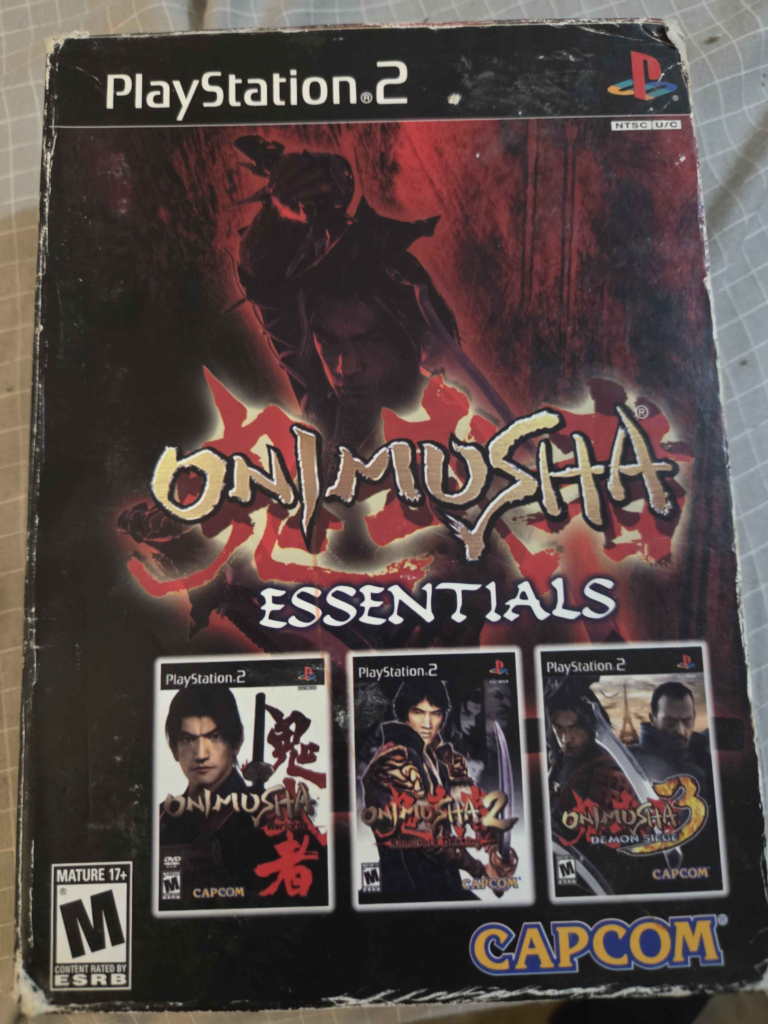
    This box set is well worn and well loved, and has been with me through a lot of my life, through both the best and worst times.

    After Onimusha Dawn of Dreams, the series became dormant. Many new console generations came and went, with no mention whatsoever of a new Onimusha. Lots of theories popped up: The series was made by Keiji Inafune, who later left Capcom and started Comcept but slowly started to go insane and ripped off a lot of people on Kickstarter. Maybe they didn’t want to bring it back because of bad relations? No one knew for sure.

    We did however, get an HD remaster of the original, which included a couple small QOL changes such as free movement with optional tank controls as well as easy weapon swapping. But as anyone who loves retro games knows, any time a retro game gets a remaster with few changes to it, the snarky asshole reviewers tear it to shreds because “It’s an old game that should’ve stayed in the past where it belongs. Who wants to play this?”

    I’d also read the remaster hadn’t sold too well either, so that felt like the death knell for the franchise. I’d resigned myself to accepting that this is just how it is for old games, and that I have to just learn to love them as they are and accept that in modern day, outside of the niche retro community, games that get brought back will always be highly scrutinized.

    And then Capcom announced a new Onimusha game in 2024.

    Expectations swelled and I was beyond ecstatic. So much so that when I saw the reveal I started squealing while sitting on the couch at my fiances friends house, whom I’d never met until that day. As someone with severe anxiety, that was extremely out of character, but it was hard to care when after almost 20 years of nothing, there was finally something new in a supposedly dead franchise you loved.

    After watching the trailer though, I had funny feeling from just watching the little bit of gameplay that it…kinda looked a bit like Sekiro. There was a lot of parrying going on, and I had this inkling that this game wasn’t going to be anything like the old games. Which, I mean, fair enough. It’s a modern game and will have modern sensibilities. I tried to keep all my expectations in check.

    Finally, the game launched on September 4th, a rare case where the release date was pushed forward instead of a delay. I started up the game, played it all the way through and, well…

    I didn’t hate it, but I certainly didn’t love it either.
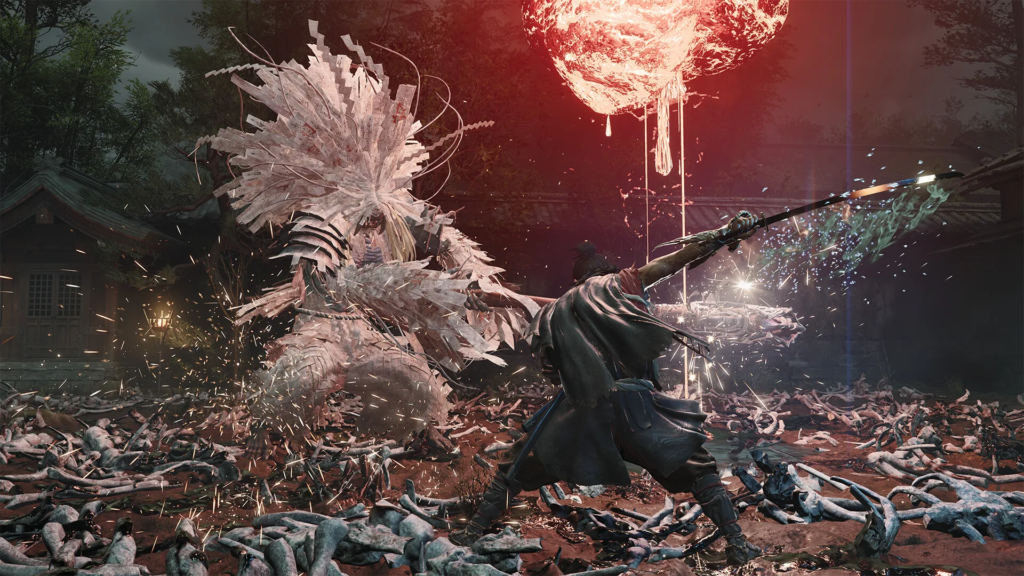
    If nothing else, the game is pretty. Not that that means much to me in this day and age.

    In Way of the Sword, you play as the legendary samurai Miyamoto Musashi, who I would assume based on how he acted is more ronin than samurai. He picks a fight with a master of a dojo, whom he wins against easily. As he flees from town after being assaulted by that dojos students, he encounters the genma. Despite his best efforts, the genma easily cut him down and he dies. While drifting in hell, Musashi awakens, only to be pulled up by a mysterious man who forcefully puts a gauntlet on his arm.

    Musashi is then resurrected and he finds that with his new gauntlet, he is able to kill the genma and he can now absorb their souls. Absorbing their souls is how the gauntlet gains strength, and he finds that there is a spirit who lives in his gauntlet. Her name is Shizuka and she serves as Musashi’s partner in the story. As the story continues, Musashi has to deal with this gauntlet being on his arm, which he very much does not want, as he feels power is earned only by oneself and should not be given freely, as he does not view the gauntlet as his own power. Despite his misgivings, he still does what he’s told from Shizuka, as he learns that the only way to remove the gauntlet is to absorb many genma souls, which will force it to come off. If it comes off sooner, he’ll drop dead for good this time.

    Later, he meets two other characters, Takamura and Okuni. Takamura is a tough old man who teaches Musashi all the intricacies of his situation as well as the genma forces, while Okuni is a kabuki dancer who stays with Takamura. Unlike the other characters, she’s much more mischievous and a bit cheerful, though she also harbors an immense jealousy of Takamura and Musashi as they have the gauntlet which gives them the power to fight the genma.

    Once all of this is established, the game then follows a set pattern with its story and progression. You spend a lot of time in the city, where you’ll run around doing story quest objectives, and on occasion you’ll do missions which will have you purify parts of the land, allowing you to explore more and find more treasures for upgrades and powerup items and the like. After a certain point you’ll be given a much longer main quest to go to a major zone that isn’t in the city. These zones are large but ultimately linear hallways that link rooms together. There’s some exploration to them, but it’s nowhere near the level of the city you spend time in. During these linear sections are when most major plot elements take place, as well as some of the games harder combat encounters.

    The thing is though, the story never really reaches its full potential and is ultimately kinda…well, boring. After a promising start, it fizzles out pretty fast and turns into a lot of running around from point A to point B, where you’ll talk to NPC’s and learn that something terrifying is happening to them. After multiple cutscenes of learning about the fun ways the writers came up with to torture humans, you then fight the big bad who caused these problems, and then the cycle repeats.

    The characters themselves also generally aren’t that interesting either. Musashi cracks jokes and one-liners and is pretty crass, albeit in a charming way at least. He doesn’t really care for Shizuka at first, calling her “gauntlet lady” when he first hears her voice which very much annoys her. I remembered reading a review before getting this where they’d said that a lot of the games charm comes from these twos interactions between each other but I found that their interactions weren’t anything to write home about, at least until near the very end of the game. They don’t ever have any real meaningful conversations with one another, as a lot of the time the dialogue amounts to Shizuka speaking in a more calm, almost robotic tone, while Musashi is just annoyed but complies anyway.
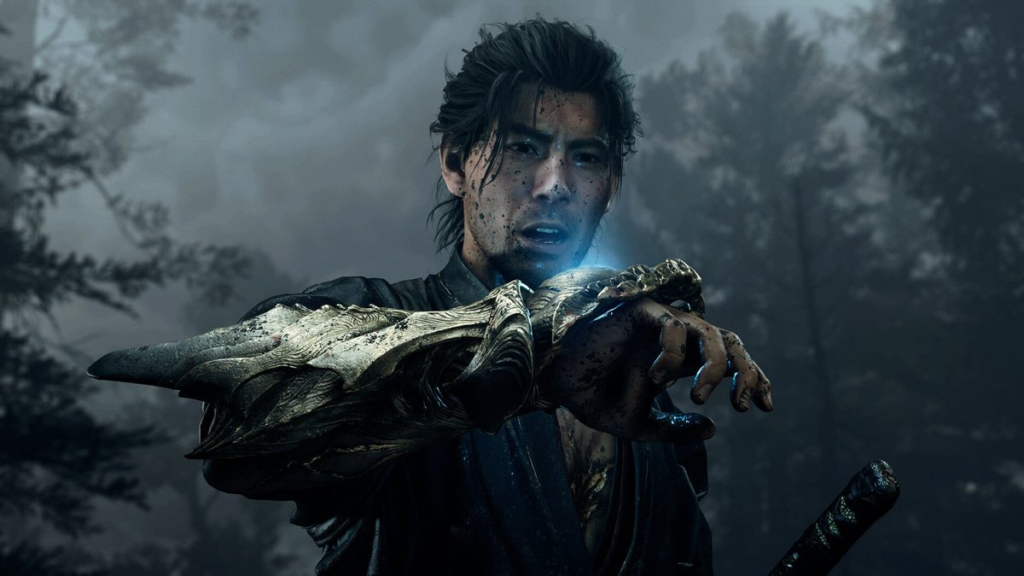
    It’s not that the writing is stilted so much as it feels like it wants to be a lot of things all at once. It wants to tell you a story that is full of lore and meaning and seeping with Japanese mythology blended with that Onimusha demonic style, yet it forgets to allow its characters to have meaningful growth most of the time.

    Speaking of Shizuka, the writers decided that because she’s Musashi’s companion that she should also be the players helper. Do you remember Ocarina of Time how people hated Navi because Navi will say “Hey! Listen!” and then explain to you something obvious right in front of you? Shizuka is, unfortunately, the equivalent of this games Navi the fairy.

    Unlike Navi, you can’t just choose to listen to her by pressing C-Up, no she’ll just say it out loud whenever she feels like it. It’s supposed to be a camaraderie type thing where she helps out, but instead she just tells you the solution outright to any problems in the game. Because this is a modern game, you’re not allowed to be stuck for longer than 5 minutes on a cool puzzle some developers spent weeks or months developing and coming up with in their level design. Case in point, there’s a puzzle in the middle of the game involving some masks. You can shoot these masks, and you realize quickly that they need to be shot in the right order.

    While I was exploring the room and looking around and experimenting with my options, Shizuka would, without any input from me, start blathering hints. As time went on and I wasn’t yet figuring it out, her hints started to become more and more obvious. And then finally, she basically told me the answer. Thanks Shizuka. She also loves to tell you what to do in combat, telling you to use your gauntlet ability to break an enemies guard, or to dodge an attack. At the worst of times it was like having a Twitch stream backseater constantly yelling at me telling me what to do, and I don’t understand why developers feel the need to do this. It’s one thing if it’s an option you can turn on, but nothing in the settings let me turn off this hint system, only the “Tips” which seemed to just be controls or explaining game mechanics.
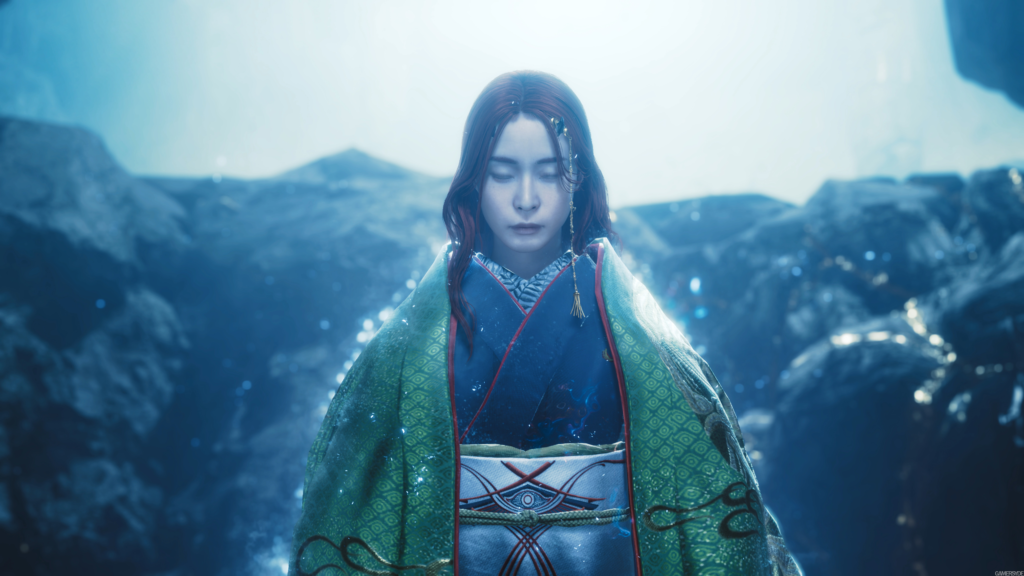
    Shizuka could’ve been a cool character, if not for the fact that she constantly tells you what to do and spoils puzzles for you if you take longer than 4 minutes to solve them.

    Because of this, I ended up learning to tune her out most of the time, and frankly she got on my nerves. It sucks too because when I finally started to think she was a pretty neat character, she’d just bark orders at me. Or if we were doing a sidequest involving looking at a treasure map, every minute or so her and Musashi would have a back and forth saying “Shit I can’t find this treasure!” to which the response would be “Maybe if you looked at the treasure map you’d find it!” like yes thanks game I’m ACTIVELY LOOKING IN THE CIRCLE PLEASE SHUT UP.

    There’s also a scene at one point where Musashi comes to terms with power, and he comes to realize that his friends were always the powerful ones and he was not because his lust for power was what made him weak. It’s an important moment for him, but also it kind of came down to just being about “the power of love and friendship.” At the end of it however, the camera pans up to the sky, and sky shows a bright blue for the first time in the game, a symbolic representation of Musashi’s revelation and growth…and then a loading screen happens and the sky is back to being gray again. I actually laughed at it a bit, and I was honestly a bit disappointed that we went back to everything just being gray and dreary again; it would’ve been kinda cool to explore Eastern Kyoto in the sunlight. I get it, the atmosphere has to be dreary because there’s death and decay everywhere, but death and decay can still happen in direct sunlight you know. The weather doesn’t give a shit.

    Another thing about the story as well is how after a while I had a cynical thought. See, this game has some of the best facial recognition technology on the market available in it, and after a point I had a realization that maybe the game wasn’t written to tell an interesting story, but was instead told to show off how cool their facial recognition is. A lot of scenes are framed to make absolutely sure you can see Musashi’s face so you can see his reaction to a comment, or see him grit his teeth as he comes dangerously close to getting swiped at. This technology is cool and all, but I’ve spent so much time in my life being wowed by amazing graphics that a lot of it starts to feel superficial.

    I don’t want to fully discredit it however. There’s a scene relatively early on with Okuni where she comes to terms with something tragic, and this scene is not just well written, but also well acted, and the facial technology served to enhance the scene. The story has points of brilliance like this, and when they do it, it’s excellent and blends together two halves the join to create a cohesive whole.
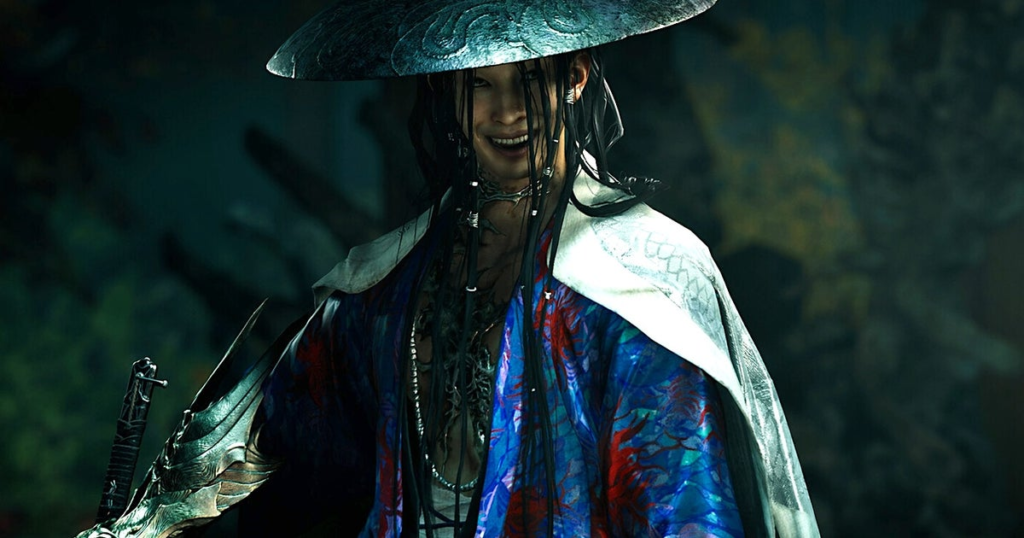
    The facial recognition is cool, but cool technology will never make up for mediocre writing.

    The problem is that most of the time, one half is impressive while the other half is mediocre, and by that I mean the writing is usually pretty boring. Take for instance both major antagonists. The main antagonist is established early on, and this fact never changes at any point. There are no plot twists. The bad guy is bad because he’s trying to destroy everything. Why is he trying to destroy everything? Who the fuck knows. He has zero motivation that is told to the player. He’s just some psychotic fuck who we’re told was once good but now he’s not. Maybe he became bad because he absorbed human souls in search of power because he has a gauntlet? Either way, he’s paper thin as far as a villain goes. At the very end of the game he taunts you with dialogue that’s just gross and nonsensical and that’s about the closest he ever comes to having a slight personality.

    My cynical side says he’s this way because he’s intentionally supposed to be pure insanity so they can show their facial recognition tech. Right before you start the final boss fight with him, he contorts his face with his hands and acts overly silly with his face, and the camera once again loves to show you how silly and insane he is. His dialogue usually comes down to, “I’m going to take over the world and I want everything to be red. Red red red red red red.” He is, ultimately, forgettable and boring, and feels like a tech demo more than a villain.

    I suppose in some ways this is pretty standard for an Onimusha game when I reflect on it. The main bad guy in the original trilogy always involved Nobunaga Oda in some form, and he didn’t really have much going for him either, though he never has much to him any game he’s in outside of being a mad conqueror type. But still, we’ve had 20 years to figure this kind of thing out, and I have higher expectations now for a sequel, especially one that took so very long to get.

    Okay, so the story was disappointing. That’s fine, a game can have a kinda bland story, but if it has fun gameplay then it can still be a good game! After all, NES games almost never told you context for what the hell was going on unless you read the manual, and some of those are legendary, sometimes literally in the case of Legend of Zelda! Way of the Sword is really fun then, right? …Right?

    Well…kinda?
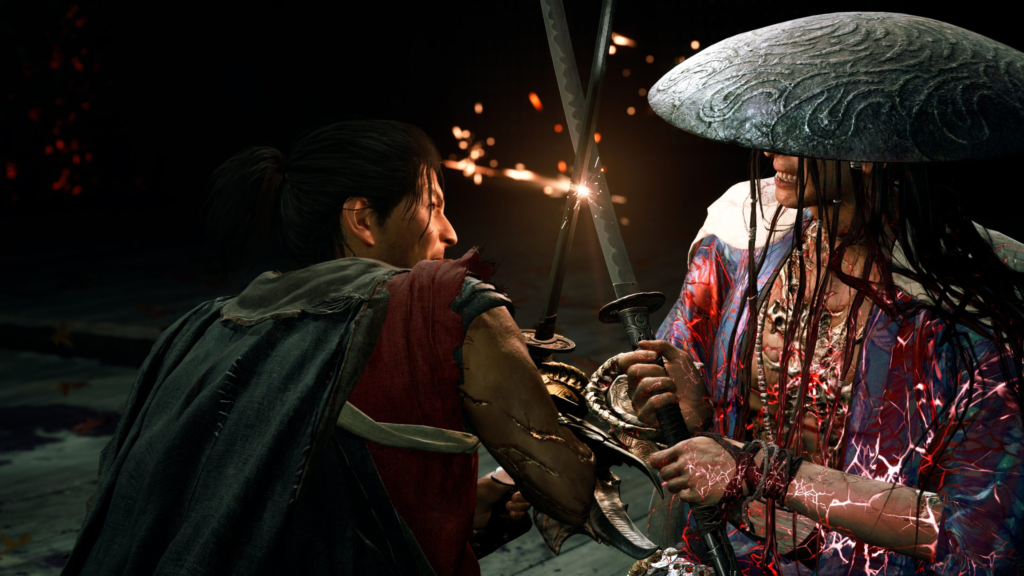
    Combat is most of what you’ll be doing in Way of the Sword, which makes sense. Musashi is capable of doing a one handed attack and a two handed attack with his sword. Think of them as a light attack and a heavy attack. These attacks can be interwoven between each other to create combos, so you can do two one-handed attacks, and then switch to a two-handed attack. As you might guess, the two-handed attack does more damage, but is slower. Defensively, Musashi has a block and a dodge. If you block just before an attack hits, you do a parry, and if you dodge before an attack hits, you’ll do a perfect dodge, and in both cases you’ll take no damage.

    You also get access to magical Oni weapons. When you absorb blue souls, you’ll fill a gauge, and when that gauge is full you can press a button and use a super strong magical weapon attack that, depending on the weapon used, does different things. The dual swords for example do heavy damage to an enemy, but they also force that enemy to expel yellow souls which you can absorb to heal yourself. The dual hammers cause small health damage but significant stamina damage, and later upgrades allow you to charge them for even more damage, but at the risk of you getting hit during the charge up.

    These are fun and can turn the tide of a fight if they’re not going your way. You can swap them easily in a wheel to adapt to your situation. Blue souls will also come off bosses as you attack them too, so there’s ample opportunity to use them as long as you stay on top of absorbing souls, which this is an Onimusha game, so you should be doing that anyway.

    Where the intricacy comes in however, is with the stamina system. Musashi and every enemy has a stamina gauge. This gauge is reduced by getting hit, or in the case of the enemies, when they’re properly parried. If Musashi can reduce their stamina to zero, they’ll be staggered for a long while and Musashi can do what’s known as a “Break Issen” on them. In the case of normal enemies, this always gave me an instant kill, and in the case of bosses it has multiple effects. Basically, combat comes down to, get the enemies stamina to zero so you can Break Issen them. Enemies that are defeated drop souls for you to absorb, and to further incentivize you to do a Break Issen, you get more souls for pulling one off.

    Does this sound familiar at all? That’s right, Way of the Swords combat is just Sekiro: Shadows Die Twice, but with added mechanics. It’s by no means a 1-to-1 copy, but about 80% of it is just playing Sekiro again. In combat, I found myself choosing in most instances to parry attacks rather than dodge them, because dodging wouldn’t reduce their stamina gauges while parrying would. In addition, parrying either has a regular parry, or if you time it frame perfect, you get a perfect parry which will do even more stamina reduction. Dodging is either a perfect dodge, or a regular dodge, and your dodge doesn’t have any invincibility frames, so you can still get nicked mid-dodge, making parrying far superior to me.

    Some other differences in combat include some occasional moments where you might attack an enemy at the exact same moment as you and initiate a clash where you have to mash the one-handed attack button fast, or another where you enter a draw where you have to counter them with the opposite attack that initiated the draw; if you started it with a one-hand, you have to then press two-hand to win, and vice-versa, where failing to press the right button (or any button) will result in your getting countered.

    A lot of these mechanics are in place to make sure you’re paying attention to what you’re doing and to discourage button mashing. They’re simple but effective and required me to think about what I was doing even in simple situations. That being said, sometimes the enemy is overly aggressive in punishing the player for button mashing, as the basic enemy can and will magically dodge your attacks, sometimes even mid-combo, and they’ll try to counter you with an attack from behind. The problem is, there’s no tell for when this happens; it just does. I’ve had instances where the enemy dodged my first attack, countered me, I then hit him, and then he immediately dodged me again and I had to counter. Meanwhile the very next enemy of the same type, I beat him no problem with one-hand attacks and no dodging happened.

    You might think, “Oh, well that’s just a mechanic in place to make sure you pay attention and respond properly!” but there’s one major thing that makes this frustrating: Musashi cannot dodge or block cancel any of his attacks. What this means is, when you press the attack button, the animation has to fully commit before the game will let you block or dodge. It’s not super noticeable when you use one-handed attacks, but you’ll definitely notice it when you used two-handed attacks. Because this dodge can happen at random, if it happens during a two-handed attack and you don’t react fast enough and instead attack again, you’ll find yourself swinging your sword while the enemy gets a free hit on you, even though you pressed block or dodge seemingly well before the attack should’ve hit you. You were punished because of luck, because the game just felt like it.

    This ties in well with the next mechanic, which I hate for numerous reasons. Most enemies and bosses all have grab attacks. These attacks are telegraphed by their hand, appendage, whatever they’re going to grab you with will glow blue. When it does, you either need to move out of the way or, the more likely scenario, you need to dodge at the right time, and you’ll do a grab counter. Being able to recognize and pull off grab counters is not just something that you do as an advanced move; it’s something you have to do to survive later fights, because grabs, as you might guess if you’ve played any fighting or action game, will do massive damage to you. And because this is a modern action game, the grab animations take forever to watch, which to me just made me feel like the game was mocking me for messing up a frame-perfect move.

    The first problem is that the tell for a grab is awful. The blue glow isn’t anywhere NEAR good enough. In multiple cases, I would get grabbed and wasn’t even aware it was going to happen because the game had a lot of stuff happening, and between the high fidelity graphics and lighting, I didn’t even recognize it, and getting grabbed by a grab you didn’t even KNOW was a grab never, EVER feels good, especially in a game where it’s designed to punish you for mistakes.

    In addition to that, most times you can’t just move out of the way of a grab. There’s an enemy who, when he initiates a grab, will run at you. If you dodge to the side too early, he’ll magnetize right towards you and unrealistically turn AT you just grab you; he doesn’t run straight ahead, and his run takes a long time. The game forces you into handling grabs in only one way, and because you can’t cancel out of your animations, most of the time you’re going to be right next to the enemy anyway, and so your only option then is to perform a frame perfect grab counter.
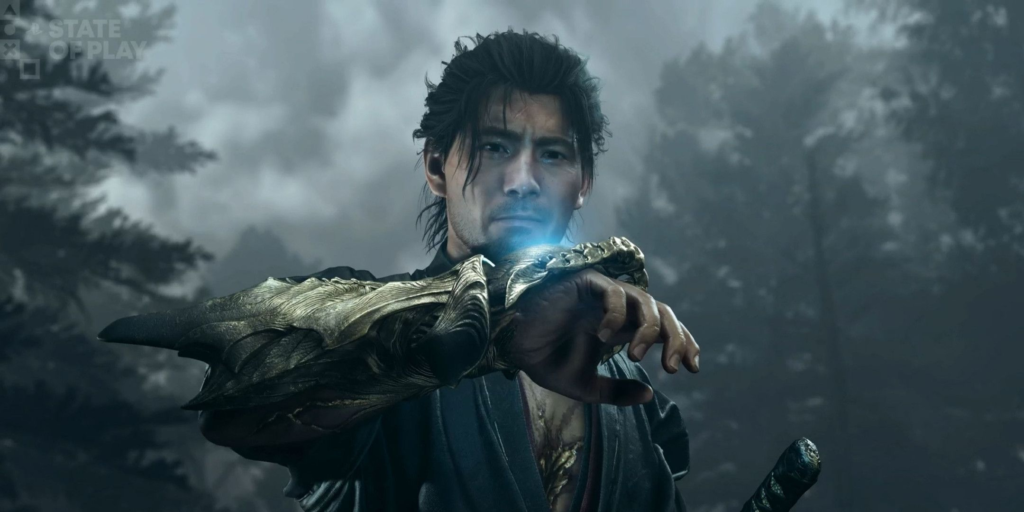
    Remember also how I said that the game doesn’t have guard or dodge cancelling? If you have poor luck and happen to be in the middle of a two-handed attack while a grab is coming at you, because you can’t cancel out of it, you’re very likely to just get grabbed because the game simply won’t let you dodge until the end of the attack animation. And because enemies don’t follow set patterns and instead use attacks at random, you can’t know when the enemy will grab. But you shouldn’t just never attack to prepare for something because even though Break Issen’s do a lot of damage, your regular attacks DO add up and reduce how many Break Issens you’d need to finish off the enemy. It’s like the game contradicts itself in some ways with this mechanic.

    Finally, the game makes it unclear -how- to properly counter the attack. What I mean is, when you get the tutorial for it, all it says is to dodge the attack. But I found while learning it that if I dodged away from the attack, the grab would still get me and I wouldn’t counter. What I found out from experimenting, and with no help from the game tutorial, was to dodge INTO the attack to get it to register properly. But dodging into the attack also has to be done at the proper time, and I honestly don’t know specifically how to do it. To this end, multiple times I would get grabbed by an enemy when I was confident I timed it well, but I didn’t, or in the final boss, I failed the timing on it so many times that the game brought up the reminder tip to tell me to counter grabs. I know I could’ve turned them off, but I had forgot to, and I ended up mumbling “Oh fuck off, game” at the tip prompt.

    Yes, doing these counters does a massive amount of stamina damage to an enemy, but forcing the player into one method of dealing with an attack is both boring and if the player isn’t good enough at the timing, just unfair. It’s easily the worst mechanic in the game and it feels poorly designed. Everything else is at least functional and intentional, but the grab mechanic was never fun to deal with in any capacity.

    Lastly, enemies can use unblockable attacks. These are obvious and long telegraphed attacks. Unlike dodges, you have enough time to prepare for these, and they -must- be parried. Thankfully it doesn’t need to be a perfect parry. Missing this does huge damage and reduces your stamina to zero, so you don’t want to get hit by these. Unlike the grabs, these are at least fair because even if they’re color-coded, they’re still incredibly obvious, and parrying one of these successfully is both satisfying and a huge relief when you pull it off. Every time I got hit by these it did feel like my fault.

    With these two attacks said, I want to bring up Sekiro again. Sekiro also has unblockable attacks and grab attacks. However, Sekiro does something Way of the Sword doesn’t: It makes it EXTREMELY OBVIOUS that an enemy is about to do something your ass needs to respond to. It achieves this in multiple ways. First, there’s a red line flash, that also includes a giant Japanese kanji. In addition to this, there’s an obvious audio cue. This symbol and that audio cue together live on in my brain from the many hours I played of that game, making me feel and think “Oh shit I need to get out of dodge NOW!” In no instance does making that telegraph of that attack feel less important, or any less dangerous. I would still often get hit by those attacks because of my own failure. But that failure didn’t come because I couldn’t see it or prepare for it, it came from my own personal mistakes. Because Way of the Sword doesn’t properly telegraph its most important attacks, it feels like a significant failure on the developers part for fairness in combat.

    Making it a purely color tell with no audio cue of any kind is also extremely unfair to colorblind players and puts them at a disadvantage. But I feel with how small the attack graphic for the grab is and how busy the game screen is, even if it weren’t a color issue, it wouldn’t matter regardless. How this got tested and no one ever pointed out “Hey, grabs can actually be pretty hard to see, maybe we should telegraph them better” is beyond me.

    “But Prinny! You should just look at the attack animation of the enemy to determine the grab!” Sure, but for one, some grab animations aren’t obvious and look similar to other attacks, and for two, they bothered to program and design a specific color and look FOR grab attacks. If they only wanted you to look at animations, they wouldn’t have bothered to indicate this attack type. And if they put it in the game and it fails to do what it should efficiently, then it should be criticized for failing in that execution. Not only that but the fact that the game that this one seemed to take huge inspiration, or at least ideas from, did it so much better means that they didn’t seem to understand why FromSoft chose to do it that way.
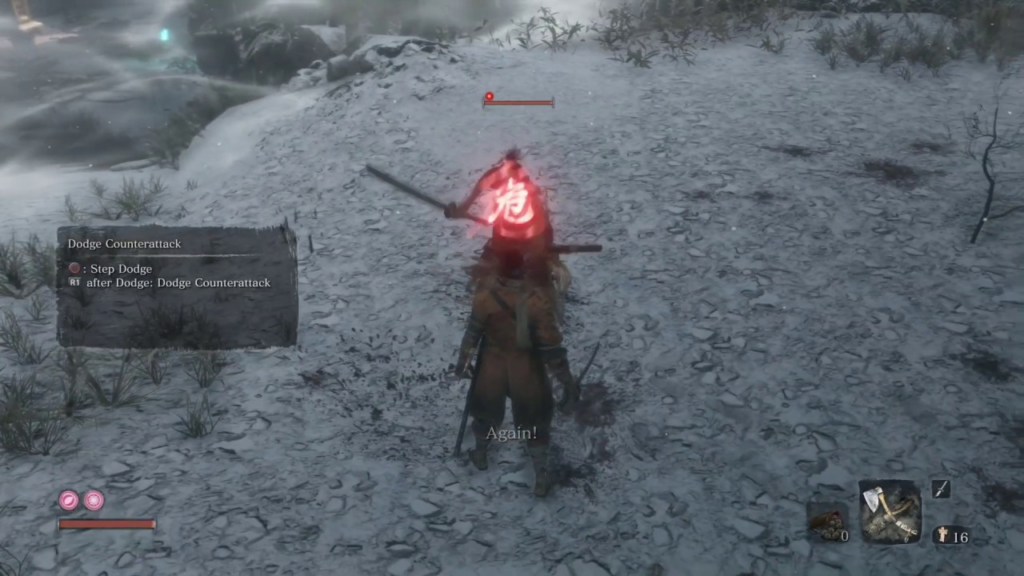
    Sekiro has perilous attacks, and the game makes it a point to make these attacks way more noticeable than Way of the Sword’s grabs and unblockable attacks.

    All of this is to say that I didn’t vibe with the combat. I was good enough at it and I learned it, but I just didn’t find it super fun. Musashi handles very heavy and his attacks having to commit makes me feel like the controls are in some ways unresponsive. I know that they’re not purely because the game is intentionally designed for your every action to have a consequence, but none of that matters if it doesn’t feel fun to play. I kept thinking back to Sekiro how I could dodge out of things, and when I pressed a button, Wolf would do the thing. Being able to dodge cancel and block cancel never made the game feel too easy, but more importantly, it felt fun to control Wolf. I loved playing as him and the combat felt super smooth. Way of the Warrior doesn’t feel that way.

    It’s like this intentionally too. The developers stated they wanted the game to be cinematic and that they wanted to combat to feel like a sword fight grounded in more realism. But in so doing, they made a game that can feel clunky or unfair, all for the sake of realism. I also find that choice baffling because…this is Onimusha. A game where demonic zombie-like creatures and mythological monsters come to life, or a game where a regular man can parry a giant multi-ton Oni monster with just a sword. What part of any of this is realistic!?

    At around the halfway point, I decided to turn the game onto the easier difficulty. Not because I was struggling, but because I was kind of tired of the combat, and I decided I wanted to see the rest of the game, but I didn’t want to delve too far into the combat itself. It’s not that I couldn’t handle the normal difficulty; I just didn’t want to. Something I noticed as I was selecting Story difficulty was that it was going to turn on a setting called “Action Prompts”. I had seen that in the settings but I had no idea what it meant, so I left it off.

    Action Prompts shows you what button you need to press in order to properly counter or dodge the enemy. It comes up as the monster is attacking you and is supposed to give you time to prepare as well as help you with combat and knowing what button to press. This seemed like a really cool feature for accessibility, but I realized it very quickly had a couple problems.

    For one, Action Prompts doesn’t tell you proper last minute timing. It only shows you at the beginning of the attack. Which means that you still have to execute a last second attack properly on your own. Yes, it’s helpful in showing you the button and reading the animation for you, but half the time, the hardest part is getting timing down. Another problem was how the prompt shows up above the head of the enemy…but if they’re not on screen, you can’t see what they’re going to do. The game tries to help with offscreen enemies by showing red or blue lines to indicate attack types, but sometimes those blue lines simply didn’t show up, and I’d get grabbed from behind.

    Plus, if there are multiple prompts on screen from multiple enemies, it can still feel overwhelming, like the game wants you to press multiple buttons at once. And because it shows up over their head, if you get pushed into a wall, you aren’t able to see the action prompt, much less the enemy.

    Story difficulty was also surprisingly challenging too. I was expecting this choice to be much more breezy, but I still had to be at the top of my game. Enemies still did a lot of damage, and while I didn’t have too much problem, I couldn’t help but feel like maybe this difficulty wasn’t easy enough for what it’s advertised as.

    Besides combat, you’ll do various other things, such as complete sidequests or explore and find treasures which have materials or usable items inside such as talismans to give temporary strength and defense boosts, and other goodies.

    The sidequests are nothing to write home about. Almost all of them consist of, talk to NPC, go to location, kill enemy, report back to NPC, or find hidden flying genma in old zones you have to backtrack through. Or the last one I mentioned earlier which is a treasure hunt. They’re pretty bland, though one of them has text which is a reference to Ghosts ‘n Goblins, and that was pretty cool. You’ll want to do these as the rewards are a lot of materials and sometimes Charms, which are equippable accessories to help you in various ways.

    There’s one other set of sidequests which are slightly more involved involving a character named Lady Murasaki. She wants you to examine strange happenings and find data on them and hopefully help the person in need. These particular sidequests are voice acted and have much more substantial rewards, but they all boil down to the same thing: talk to NPC, go to location, talk to another NPC, kill some enemies, run back and talk to NPC, and repeat until finished.

    The stories they tell, while more compelling than the standard sidequest, aren’t -that- great. They’re good, but none of them really wowed me or anything. Murasaki shows up in her butterfly form in these quests, and she, like most characters in this game doesn’t have much personality either. She kinda just says things like “This seems to be the work of the genma! You should help them! Examine this for me!” and then you do the thing and she says thanks and…you’re done. The most that happens is Musashi bats at her when she flies near him, so I guess that’s something.

    In between all this, you’ll also be upgrading your stats with materials. You can upgrade your clothes, sword, and gauntlet, which affects your health and stamina, damage, and your ability to absorb souls as well as a second gauge for your Oni weapons respectively. While the health upgrades feel significant, I never felt like upgrading my damage meant anything. Damage upgrades increase in percentage increments, and most of the time, you increase that amount by two percent each level. Considering you start at 100 base damage, an extra 2 isn’t all that significant, nor is 110 damage for that matter. If an enemy takes 4 hits to kill at 100 damage normally, 110 damage isn’t any different than hitting the enemy 4 times regardless. More likely than that, you’ll probably break their stamina gauge and instant kill them anyway, so leveling your damage feels…almost meaningless.

    By the end of the game (so around 25 hours or so), I had maxed out my weapon, and the max damage increase is 100%, so you do double damage. But by the time you get to this point, most of the genma aren’t weak variations anyway, so you don’t really get to see a significant difference in your damage output. Not to mention the amount of effort it takes to gain levels with materials and how every level increment increases by such a minuscule amount, it ultimately feels useless.

    Let’s compare this to Onimusha: Warlords, the first game. In that game, weak mook genma takes 4 hits to kill from your lightning sword, the first major weapon. When you upgrade it with souls, the enemy instead takes 3 hits, and at max level, they then take 2. This feels significant, and it’s clear that upgrading your weapon mattered. The fact it takes you about an entire playthrough just to double your weapon damage when that was something you could feasibly do within the first 30 minutes of the original really shows that upgrading wasn’t a consideration in the slightest to making the game easier. Not to mention the original was way simpler with upgrading, making it feel more cohesive and more focused on the action. With Way of the Sword, it feels much more arbitrary as a result.
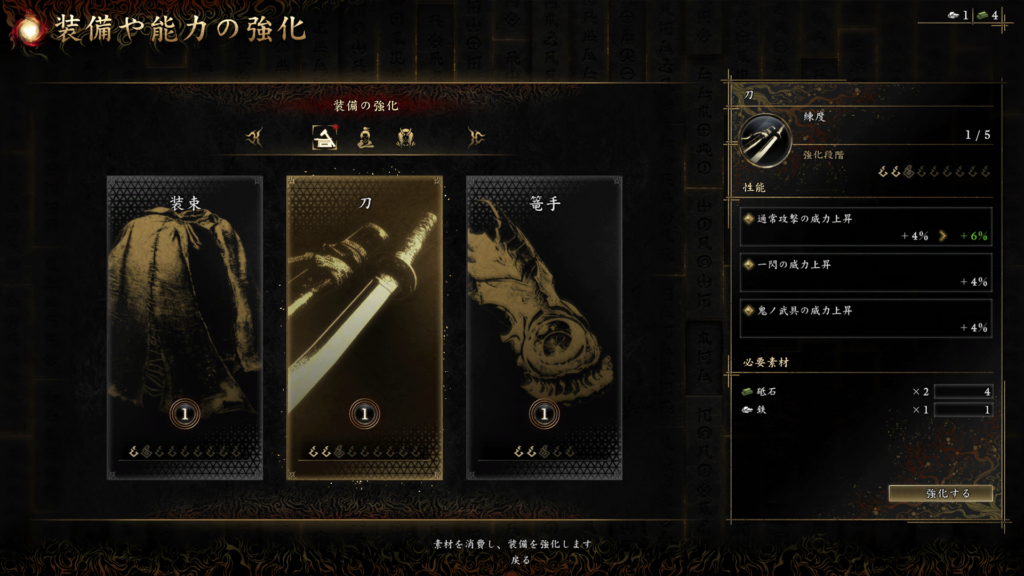
    The stat upgrades generally felt disappointing and underwhelming.

    Finally, you have skill trees. Skill trees are either far too useful and you wish that they would’ve just given you this ability from the start, or they’re meaningless and you just kinda get the abilities to have them. Thankfully Way of the Sword leans into the latter, which is way more tolerable, though it does have a good mix of meaningful abilities. Getting the “deflect” ability was a game changer for me and I used it often, while also being able to equip more charms and reflect arrows was very useful.

    I hate saying all these complaints because this game was very clearly made with love. The facial recognition tech is really cool, and it was impressive to see it when it happened. The extra bits of lore you get from the collectible Lion Dogs is neat. The temples in the game were designed as their real life counterparts, and the developers got the help of the people at the temples to get their design just right. There’s extremely beautiful ukiyo-e art done by insanely talented artists that are breathtaking to look at. The choreographed kabuki dance by Okuni was done by a talented kabuki dancer and is enthralling to see. The enemy designs are sufficiently creepy, and the bosses all look really cool. The environment design is really good, and the game keeps a stable framerate on a base PS5 on performance mode.

    The best way I can describe how I felt playing this game is just disappointment. The gameplay started to feel stale after a while, the mechanics, while fun at first, overstayed their welcome and the flashiness lost all its meaning real fast. For as cool as the Oni weapons were, I wished I could’ve equipped them and used them too. Wouldn’t it have been cool if you had other weapons to equip besides your katana like in the old games? What if the magic attacks were mapped to those like in the old games, or if those weapons you had new combos you could pull off, or maybe you could dodge and block cancel with a weapon at the cost of reduced damage from that weapon? These are just spitball ideas that I think would’ve gone a long way to preventing the game from becoming too stale.

    The fact that I didn’t like the combat mechanics much because of certain design decisions made me realize that by the time I was at the halfway mark, I was ready for the game to be over. If this series hadn’t meant so much to me, I wouldn’t have bothered finishing it. But this is Onimusha, an action series I love and have enjoyed for a long while now. You saw my picture of that box, I played the first 3 games many times, and they were all great! I even got to play through Dawn of Dreams with my late friend who passed away, and now my memories of that game carry weight and meaning to me, and I love that game because I was able to have those memories with a dear friend.

    Perhaps this is unfair to the game, to place it on such a high pedestal and to give it these expectations. Not to mention I know why the game is the way it is and why it plays the way it does. Games in the modern day have to adhere to whatever the modern stance is. That stance will change in another 10 years, and expectations will be different. Design will in turn reflect what is necessary for the time and what people want and expect. Way of the Sword could never be like the old games because to do so would doom it to failure from everyone else who wasn’t nostalgic for the old way of doing things. I recognize this and understand it completely.

    And yet I didn’t like it, and I feel like something I loved became something else. Like myself, it too has grown and adapted to what it needed to be to survive. And it will survive because it reviewed well, and others seem to love it, and it has already sold over a million copies. Video games are a product, and they need to sell, and Onimusha did what it needed to do. No doubt Capcom will see it as a success and this style of gameplay will propel it into potential sequels which I’m sure will play just like this with some changes.

    But with my current track record of disappointment with modernity of gaming, I don’t think I’ll be checking it out. In truth, I’ll probably be avoiding most new releases for a while now, with the exception of the Ocarina of Time remake set to come out in a couple months at this time of writing.

    Way of the Sword is a game I was excited for, but I left it feeling deeply disappointed after waiting 20 years for it. It’s a game that I played, went through, and I’ll probably forget about it at some point. Or at the very least it’ll come up in conversation and I’ll remember playing it and that feeling of disappointment again.

  • An Ode To Odin Sphere: Why Leifthrasir Is A Perfect Game To Me

    An Ode To Odin Sphere: Why Leifthrasir Is A Perfect Game To Me

    (This post contains major story spoilers for Odin Sphere.)

    Being that my online persona is ‘Prinny’ you’d assume that Disgaea would be my all-time favorite game. And you’d be correct at one time: Disgaea was my favorite game when I played it back in 2003. It just so happened that I first started to use the internet around that time and chose to encapsulate my online self in that series. It feels like a tradition I started as a preteen and isn’t something I think I can change at this point, having been online for about 22 years now.

    It was 2007, and I went to our local Family Video rental store which opened in our small town in rural Kansas. Many rental stores had tried to open up there, but a lot of them inevitably went out of business at some point. Family Video opened and just wiped any competition out, with their better pricing and better selection. The rental store business was vicious, even so late in its lifespan. Our old go-to was Hollywood Video, but they, like so many, also closed down around 2005 or so. Japan may hate rental stores, but for myself, and many others I imagine, rental stores were how I was exposed to so many different video games I’d never have tried otherwise.

    Renting Odin Sphere was like renting anything else: I looked at the shelves of PS2 games from A to Z, I spotted it, thought it looked cool, and picked up the green box behind it and rented it for five days. It’s something I’d been doing for a long time at this point since my parents were divorced, and on weekends it was Dad’s turn to look after me, so we’d go to the rental store where he’d rent a movie and I’d rent two games.

    What I wasn’t ready for was how much I ended up loving this PS2 game. From the moment the opening sequence played showing the characters and the games theme played, I knew I was in for something special.

    Seeing this on the shelf in 2007, I was quickly enamored by it and had to know more. It ended up being a decision I wouldn’t regret.

    Odin Sphere is a game by Vanillaware, who are well known at this point for their hand-drawn 2D graphics. Every single element, from animation to background is made by hand, so as a result their games take a long time to release. The studio is headed by George Kamitani, whose first game was on the Sega Saturn, Princess Crown, which was created by Atlus. Princess Crown never saw an English release, even when it was ported to the PSP years later. GrimGrimoire would be the first game North Americans would get to experience a Kamitani game, with Odin Sphere debuting one month later, though Odin Sphere was originally supposed to be released first but was delayed.

    While I love the PS2 original, back then I remember struggling with it a lot. The game is a 2D beat-em-up style game where you have a POW gauge. The gauge depletes when you attack or block, and if that gauge runs out, you’ll be stunned for a few seconds and open to attack. This is the exact same as a stamina gauge that would be popularized later by Demons and Dark Souls, so keep in mind that the idea of something like this was incredibly foreign for the time. You couldn’t increase the POW gauge or anything however, so it was stuck the way it was.

    In truth, I haven’t played the PS2 original in about 15 years or so, so my recollection on it might be fuzzy, but needless to say, while I adored the game, there were a lot of humps to get around and figure out, such as the leveling system, or how the combining and potion system worked, or even the limited inventory system with its bag system being practically lifted straight out of World of Warcraft of all things.

    I did eventually beat it by renting it enough times (Sorry Vanillaware. I bought the game and the remake later, I promise!) and it was tough but I did it, and despite any hardships, I loved my time with it. So much so that the game and its art inspired me to draw its characters, which during that time I was pretty obsessed with drawing and I had thought my life path would be art. That…is not what happened, but that’s a story for another day.

    This is the only picture I have left of this art. It was taken on an old phone by a dumb teenager who didn’t know how to take pictures of things very well.

    Years later, an announcement happened that would rock my gaming world: Odin Sphere was getting a remake. Titled Odin Sphere Leifthrasir, I was beyond ecstatic for it. While the game continues to look amazing on the PS2 in SD, I couldn’t wait to see how it looked in HD. There was still a bit of trepidation though, as I recalled the game being bumpy in places, but I was older now and none of those bumps were going to get in the way of getting to experience this game again. I had a job and income at this point, so I pre-ordered the collectors edition in anticipation for the game.

    Not only did the game look beautiful, but they fixed every single problem I had with the game. The additions were meaningful. The stage layout was changed to be much more diverse, and yet the core essence and gameplay of the game remained. The POW meter is instead used for the brand new skill system, and when you get the hang of it as well as juggling enemies, it’s one of the most satisfying feelings ever. By the end of the journey, I had come to a realization.

    Odin Sphere Leifthrasir is, to me, perfect in every single way.

    The story is the same. The cutscenes are the same. The music is the same. The gameplay is changed quite a bit to make for more variety in levels, the leveling system is simplified instead to just be one main level which is much easier to manage. Hell, they even included the original game with all its quirks and nuances intact as an optional thing to play, just with HD visuals, which is a fantastic inclusion and makes Leifthrasir the definitive way to experience Odin Sphere. If you’re a purist, you’re not left out, and I think that’s an incredibly thoughtful inclusion.

    I’d like to talk about the story next, but I also want to say that you should absolutely experience this story for yourself if you can. While I’m omitting a lot of important details, I’m also going to be going over the general plot, and character stories, and I would encourage you to play the game yourself before moving on if possible.

    Leifthrasir fixed every complaint I had with the gameplay element and created something incredibly fun that honestly I need to go back and play again sometime soon.

    The games story is about a young girl, Alice, who walks into an attic and finds a book on the floor. She picks up the oversized book and sits on a chair, with her black cat joining her, and begins to read a story. Thus does the tale of Gwendolyn and the advent of Armageddon begin.

    The plot is divided between five different characters, each with their own play style. They’ll often meet up with other main characters you’ll play as, sometimes as friends, sometimes as enemies. As you experience more of their stories, you’ll eventually find that these stories all are told on a timeline. Each character experiences the events of the unfolding story at different places and at different times, and in order for you to understand the whole, you have to play as each character to see what happens in the grand scheme.

    Much thought was put into the pacing, as playing as Gwendolyn first shows a series of events, and yet her story is only a fraction of what occurs. Yet each story is it’s own full story, where you start at the beginning and have a conclusion with no loose ties for that particular character.

    Gwendolyn’s story is about a valkyrie princess who believes it’s honorable to die in battle and that is her purpose in life. Yet her innermost thoughts torment her, and she has doubts about her father, Odin, and his love for her. She combats these feelings and inevitably betrays the kingdom to save it, yet her father, in his grief, makes the decision to punish her by forcing her into a life of love, where she will live and never achieve the valkyrie death she was promised. This punishment however, becomes a revelation of a different kind of life, where she does find true love, and in so doing, realizes how powerful love can be. Does she feel this love because of the spell cast on her, or is it because this is how she truly feels? For Gwnedolyn, she chooses to believe in the latter.

    In Cornelius’s story, he is poisoned and left for dead in the underworld, but instead he finds that he is transformed into a Pooka, a rabbit-like race who are the remnants of a civilization whose king’s avarice cursed them to be so. He obtains a sword and flees the underworld, only to find that his kingdom has been taken over by one of the Three Wise Men, and he realizes in his form that none will know him as the rightful prince.

    In Mercede’s story, she is a princess of the elves, and is quite spoiled as a result of her upbringing. Her mother is killed in battle against Odin’s forces, and while she mourns, one of the advisors takes the opportunity and asserts himself, telling Mercedes at first what to do, but then taking complete control from her, as her troops start to lose faith in Mercedes because she does not know what to do, and watches as her kingdom is slowly taken from her.

    Oswald’s story is about a man who has chosen power, but at the cost of his humanity, and if he continues to use his power, he will be consumed by it and lose his humanity at any moment. Death is always looming around him, and yet he has the ability to fight them off. However, one wrong move will mean the end. But he finds new meaning in his life when he meets and begins to develop feelings for a valkyrie warrior, Gwendolyn.

    Finally Velvet’s story is about not just her, but the state of the world. A cauldron is set to be the cause of Armageddon, and yet the world and its powers seek the ring Titrel to take control of it, hoping to use its own power for domination. Velvet knows that this cauldron will bring about the end of the world, and so she fights on to stop the Armageddon from occurring.

    After the stories all conclude, a sixth story is unlocked, where we learn that the cauldron has been activated, and is bringing about the end times. At the end, the five heroes must go and defeat the literal harbingers of the end to stop the Armageddon. It is here the player must make a decision, and choose who will fight which boss. If the player chooses correctly for each boss, then the true ending will play and the true final boss will be fought.

    If the player makes even one wrong choice however, the bosses will still be fought, but the end of the world will still come, with an incredibly depressing bad ending cutscene. What’s amazing about this isn’t just how the player can choose these, but how making the wrong choice will sometimes result in unique cutscenes, as these bosses are also characters you’ve met on your journey. When you pick the wrong choice, you see a cutscene where that harbinger kills the character you’re playing as, and it really gives a powerful sense of your choice; this was completely your fault.

    All of these elements are so woven together that it creates a cohesive story that, although in some ways cliche or a trope, surpass this because they’re so well told. Yes, Gwendolyn’s story feels like it becomes a story of her becoming a damsel, but in truth, her story is just as much about her fighting for Oswald, as he is the one who is kidnapped. Yes, Cornelius’ story is a sort of Beauty and the Beast story, with him doubting his lover, Velvet would ever love him as he is, but it’s just as much about him coming to terms with who he is, and how he can achieve just as much in his current form.

    This is a story that has stuck with me ever since I first experienced it, and between the writing, the localization, and the voice acting, I enjoyed every single second of it, from start to finish. I love every character, every scene, every single thing about it. It never gets boring, never languishes in hard to understand lore like many stories of this ilk do, and it manages to make every character feel alive and full of emotion. Every character has a purpose in some form, and they all have their own ambitions and wants and desires, and the world feels like it’s lived in and not just an incredibly beautiful prop. That the game is then hand drawn between the art and animation only serve to enhance the story, with the character design not being afraid to be incredibly over the top. Brigan, for example, is a gigantic human that frankly makes absolutely no sense. And yet, he is supposed to be imposing and evil, and his design as well as highly over exaggerated size serve to exacerbate this idea, which this could only be accomplished by choosing a highly stylized art style.

    As if the gameplay and story weren’t enough, the soundtrack is a fantastic, sweeping orchestral masterpiece. From the games theme, to the sad and yet triumphant “A Fate Accepted”, and to the bombastic and powerful “Battle In Ringford”, every piece properly accentuates the location and scene being shown. It’s a crying shame more people don’t talk about this games soundtrack because it’s a wonderful experience worth giving a listen to. Basiscape is really good at what they do, and Odin Sphere is no exception to high level of talent that each of the composers for this game brought to the table.

    I often tell people how ActRaiser changed my life, being the first ever video game I played, and how it and its story and gameplay all shaped who I am, both as a gamer and as a person. ActRaiser is also a perfect game to me, but to have it stand alongside Odin Sphere is a huge honor. These games go beyond something I play and are something that I experience. They change the way I think, the way I feel, and they bring me an unparalleled joy that I don’t think words could ever describe. Often times when I feel lost, or I feel like my hobby is faltering, I need only look at Odin Sphere or ActRaiser and remember what these games did for me and how they made me feel. They’re why I love video games and why I will always advocate for this medium.

    They affected my imagination, helped me to tell my own inspired stories, and even got me to draw them. I think it’s a wonderful thing when a piece of media can inspire someone so strongly that they want to become creative with it, from drawing it to making a remix of the music, or even writing something about, whether a blog post or fanfiction. It’s a testament to what someone experienced from it that it spoke to their soul and inspired them to do something. More than review scores and more than praise, I think that’s the most powerful thing a piece of media can do. To make a person feel enabled to create a work, or to help them look deep within themselves and to think critically about them or something. This is the apex of what art can do beyond anything else, and for me, Odin Sphere is that very thing.

    I won’t say Odin Sphere is obscure or anything, but it always felt like it was swept under the rug in a lot of ways. Sadly, Vanillaware wouldn’t gain any kind of popularity until Dragon’s Crown, and Dragon’s Crown only gained any level of popularity because someone got mad at one of the main characters having large breasts, and the media picked up on it. Which ultimately didn’t change anything and just made more people buy Dragon’s Crown, whereas it probably would’ve remained a niche title if they hadn’t said anything. Dragon’s Crown is a great beat-em-up as well that has no sexualizing in it whatsoever, so it’s unfortunate that a company that makes games like this gained notoriety both from its critics and from the annoying and creepy “lusty” types.

    Regardless, I will always keep Odin Sphere close to my heart. I’ll always remember it for its wonderful characters, its amazing soundtrack, its beautiful hand drawn art, and the fun and engaging gameplay. Video games are, and probably always will be, an important part of who I am, and I’ll happily point to Odin Sphere as a game to play to understand who I am. When I was young, the only thing I had a lot of times were video games, and even if what I’m saying seems pathetic, it’s how I feel and a part of who I am, and considering the amount of joy and inspiration this game brings me, it’s not something I’m going to change any time soon.

    Oh and, if you haven’t figured it out yet, this site isn’t just called Prinny Sphere because this is a blog about my world. It’s also a combination of two of my favorite things combined. Just like how PrinnyOfTime, my online handle, is also a combination of two of my favorite things.

  • The Spider-Man Games Are Excellent Movies, But Okay Games

    The Spider-Man Games Are Excellent Movies, But Okay Games

    (This post contains spoilers for the video game reboot of Spider-Man, Miles Morales, and Spider-Man 2.)

    I tried really hard to transition to being a PC player. I finally got a rig that could handle most games I threw at it, and I was really happy with the results. Unfortunately, the world changed, and I was unable to get a job to try and save up for any upgrades. And, at this time of writing, upgrading a PC has become an impossible task unless you have a lot of disposable income. Feeling defeated, I threw in the towel and switched back to console for gaming and with the help of my amazing partner, we got a PS5 along with PS Plus.

    While browsing the games on their game collection, I noticed that all three of the Spider-Man games were on them. I had recalled watching a streamer play through the first one and thinking it looked fun, and I had bought it for my partner on PS4 when we started dating and he enjoyed it. In addition, we’d just watched the Tom Holland Spider-Man films, so I was in the mood for it and gave it a shot.

    I ended up enjoying it and almost got 100% on it, doing almost every extra thing you could do. I got a little burnt out though, and stopped for a bit. Here recently I picked up Miles Morales and also enjoyed it too, though less than the original since it was a copy-paste of the first game, but I at least went into it knowing that. Playing through that one made me a little excited though because at this point I was a bit tired of the formula, and I was excited to see how much different Spider-Man 2 would be, being a proper sequel. I downloaded it, started it up and…

    …With some minor exceptions, it played the exact same way as the other two games before it.

    It wasn’t that I didn’t enjoy the game or anything, it’s just…I was a bit tired of the formula and I had hoped maybe the game would change things up. And sure, it does in certain ways like being able to Web Glide, but it was still just the same old Spider-Man game formula, just prettier.

    After doing more and more thinking after spending around 40 hours total on these games, the Spider-Man games are really good movies, but okay games. Let’s break it down a bit.

    The story of each of the Spider-Man games all follow the same typical formula: By day Peter Parker is a kind of bumbling but really bright nerd with some of the worst luck in the world, while also being a superhero by night. Or, well, whenever he’s needed, which in these games is after maybe five minutes of getting to be a normal human. In both 1 and 2, they both have the same overarching plot of someone Peter loves and trusts who gains some kind of cool power or ability, but they ultimately turn and he has to fight them in an emotional showdown.

    That’s the thing with these games and their stories: They’re well told and well written, but they’re also painfully predictable. There’s a sequence in 2 for example where Peter goes to punch Kraven, but he’s both blocked and stabbed in his side and casually tossed aside. Yes, the guy who has fought a giant human Rhino, a Scorpion, and all sorts of other magical entities is finally done in by a large man with a knife.

    Anyway there’s a whole huge sequence where Peter is dying and you’re playing as Mary-Jane and you have to move him forward in a scripted sequence while shit is hitting the fan around you. Peter ends up dying to his wounds and his friend Harry, who is infected with the Symbiote, cries out and infects Peter and saves his life.

    This whole sequence should be emotional, and while the acting was phenomenal and the sequence gripping, I ultimately knew Peter wasn’t going to die. It was far too obvious, between the fact that he’s the main character and the fact that on the box art Peter has black webs. The whole sequence felt like an excuse to just give Peter new powers to use to vary up the gameplay, which might be a really cynical way to look at it, but it’s just how I felt at this point.

    The second game also has an obvious plot point where Peter regularly pushes aside Miles once Harry gains his symbiote powers to instead hang out with Harry, his childhood friend, and it was just screaming out loud that this was going to become some kind of drama in the plot.

    Despite all this, I have to reiterate that, minus the Kraven thing with Peter genuinely being kinda funny, this is all well told and acted. The presentation is top notch, and it’s clear that a ton of effort went into all of this. Visually the game is gorgeous, with tons and tons of details in New York if you just walk around, but also just as striking from the sky where you’ll spend most of your time.

    In fact, the side stories are some of the best parts of the game. I genuinely teared up at the conclusion of the Howard side quest in Spider-Man 2, and the sequences both with Hailey spray painting a wall and a young Peter Parker delivering his photos to the Daily Bugle are top notch, both with meaningful gameplay interaction and character building. They absolutely nailed these segments, and the choice to make Hailey’s gameplay segment incredibly muffled because she’s deaf was a powerful and meaningful choice.

    I loved the side missions in these games, and getting to pet a cat with an adorable Spider-Man plush was an excellent bonus.

    Where I became much more mixed, and where the cracks really started to show though, was the gameplay.

    All three games are beat-em-ups with a simple combo system, but with more of an emphasis on fighting smarter to make fights go smoother. In the first game you have access to your gadgets, which come down to webbing up the enemy in some way. While you can just beat a guy senseless, you’ll actually KO them immediately if you web them up and knock them into a wall or the floor. Doing this requires them to not only be fully webbed up, but for you to force them onto said surface, usually with a throw or a gadget.

    Miles Morales and 2 try to add some variety to this by adding abilities, where Miles can use his electrical Venom powers in addition to basic webs to cause a lot of stun effects and even has a powerful single hit punch. In Miles Morales, Miles can only use these powers when his Focus bar is full, a bar which only fills when you successfully punch an enemy. This bar can be expended to heal yourself, or you can use a full gauge to use a Finisher which instantly knocks out an enemy. It creates a risk versus reward system, where you have to use your healing currency to do a lot of damage instead, but if the battle goes south, you won’t be able to heal much. It was a good system, and I actually liked playing as Miles a lot with all the new options in Miles Morales.

    Spider-Man 2 however, throws all this on its head, and for every step forward, it manages to take two steps backwards. Now, your abilities are mapped to L1 and a face button. The catch is, these abilities only recharge when you punch an enemy. In addition, the Focus bar is back, but whereas in the other games you could get a partial heal from a partial gauge, now you can ONLY heal when a gauge is full, which was kind of a baffling change. On the default difficulty, enemies hit pretty hard, and taking a hit, especially gunshots, do a lot of damage if you don’t properly dodge them. Restricting the healing to only full gauges felt like an unnecessary difficulty increase, because while you might think the enemies are a touch weak in the prologue against Marko’s sand clones, they very quickly go back to their hard hitting selves once the Hunters are introduced.

    Here’s the thing though. In each of these games, they all come back down to just mashing square against some guys in some shape. For as cool as the skills are, most of them don’t feel useful or powerful. In fact, a lot of them are geared towards launching enemies in the air, but you have so little area of effect attacks, that launching an enemy in the air only feels like it just delays them from possibly attacking you for a while, and at that point you may as well just keep them airborne and dodge bullets from the inevitable assault rifle guy who is always there.

    I’d learn guitar from this skeleton.

    The main missions in all three games all function the same way: You swing to the marker, a cutscene plays, Spider-Man lands nearby, you fight some guys, and then you move forward in a scripted building. Either that or you walk around outside your costume and get to experience a slower paced plot-focused segment. This same formula is repeated in all three games, and by the time I got to 2, I didn’t feel like I was playing a sequel, rather the exact same game I’d just been playing.

    There’s also a stealth mechanic in these games and I just…I hate it. You can scan enemies and the game will tell you if doing a takedown on them is “Safe” or “Dangerous”. If it’s Safe, you’ll take them out without alerting the other enemies. Dangerous means everyone will learn about your presence. In order to move enemies, you can shoot webs either near them or at certain objects that glow blue to make them make noise. The problem is, what usually happens is the enemy you want to take down as well as the enemy nearby him will investigate the noise or the web, and they’ll never leave the danger state. Many times I had two enemies who were programmed to be near each other and I could never get one of them to move far enough away for the game to give me the Safe prompt.

    In addition to all that, Spider-Man 2 somehow manages to make this worse because in the first two games, it’s clearly labeled when you can do a square button Perch takedown because the symbol is marked with…well, a pink square. This DOES NOT EXIST in Spider-Man 2 and I admittedly just GUESS by mashing square when I want to do a Perch takedown. That they got rid of that is even more baffling to me than the partial Focus heal. For a game that has heaps and heaps of accessibility features (which is fantastic, don’t misunderstand), the fact the UI is somehow WORSE in the sequel is just…amazing. Maybe there is a difference in the UI to show you when a Perch takedown is possible, but if there is, I didn’t notice it.

    While I’m complaining about stealth, in Spider-Man 1 and 2, you have multiple missions where you have to play as MJ and sneak past various characters, either to escape or to find information you’re not supposed to know. While these segments are supposed to be a break with the Spider-Man punching action, they’re really just annoying set-pieces with instant failure conditions if you’re caught, which can be really frustrating, especially if stealth isn’t your strong suit. Miles even has a section like this in the first game since he doesn’t have his powers yet and his section where he has to flee Rhino is especially egregious.

    Spider-Man 2 brings this back, but at least MJ has a stun gun now, and getting spotted isn’t immediate failure, but getting shot twice is. Which if you do get caught, happens really fast and the enemy is likely to just find you again anyway, and when there’s two guards at once…well, good luck. Sure you can run at them and stun gun them, but both times I got caught and did this, I just got shot a second time and failed regardless.

    The cherry on top was how during this section I had stunned a group of enemies, did a mission objective, and on the way to the other one, found two of the guards I had knocked out were now standing back up, not in a T-pose, but clearly glitched out and not moving. It was kind of funny, but it also just made an already annoying segment feel that much more janky and annoying.

    It isn’t obvious, but I tasered these guys, and after I came back, they stood up like this. I could walk through them and everything.

    Another thing to mention as well is that despite the game being open world, there’s…really not a lot to do in the game. As you complete the main story you’re drip-fed new activities to complete, but most of them consist of picking up a thing, going on a scavenger hunt, or doing a traversal or combat challenge to earn a currency for upgrades. At random times a crime will occur, but it’s randomly pulled from a small set of kinds of crimes which with the exception of vehicles, boil down to “beat up the bad guys” in some form. Once you do those activities, there’s…not much else to the world. Which is a crying shame because it’s incredibly beautiful and meticulously detailed but ultimately it’s the kind of open world you’d look at and say “wow this is pretty.” and then once the activities are done, you shut the game off and forget. It’s open world because it has to be and not because it adds much outside of visual value and I suppose immersion.

    You probably would think from all of this that I hated these games and wasted 40 hours of my life, or that perhaps I’m being too harsh on them. Making video games is incredibly hard, and I have nothing but the utmost respect to game developers, especially in times like these. But the thing is, I enjoy these games. The combat is perfectly fine, and even with the complaints, it’s still pretty fun, even if it is just a copy-paste throughout all three.

    The problem is, these games are critically-acclaimed and are console best-sellers, and they’re also an extremely good example of why I, and I’m sure many others, are losing faith in the video game industry: Spider-Man and its development is so busy trying to be a great movie, that it forgets to be a great game.

    It’s a game where all the effort felt like it went straight into everything except game design. The graphics, acting, music, accessibility, story…those were what the main focus was. That the gameplay is just a borderline copy-paste with very little variation feels like proof positive of that idea. I have no idea what the budget on this title was, but with how expensive games are to make nowadays, it just feels like almost none of it went into making the game part fun or different.

    My main gripe with this is mostly Spider-Man 2. The first game I can forgive and give a pass since…well, it was the first one. Miles Morales was intended to be a side game and to give Miles his personal origin story, and it was fine, but by the time they got to 2, there’s an expectation, not just in graphics, but in gameplay. And there’s just not enough to justify it.

    I was playing a game to experience a movie more than I was playing it to play a game.

    This might be an unpopular opinion or a hot take, but the most important aspect of a video game is the gameplay. It doesn’t matter how pretty your graphics are. It doesn’t matter how fantastic your story or actors are. It doesn’t matter how epic the musical score is. If your game isn’t fun to play, it’s not a good game. If your game becomes stale to play, then it starts to just become unfun.

    Here’s the thing: If I wanna see a great film, I’ll go watch a movie. A video game is not a movie. They’re fundamentally different things, and the game industries obsession with trying to become interactive Hollywood and its ballooning budgets are what are slowly killing it, because they’re trying to make games into something they aren’t.

    People focus so much on a games presentation that they don’t realize that the gameplay feels a bit hollow, and becomes more about experiencing an interactive movie than being a fun game.

    It’s why a lot of people are turning towards indie games. It’s why people are such die-hard Nintendo fans, because Nintendo is a gameplay-first developer. It’s why despite people mocking and lamenting Nintendo for being so behind technologically and with hardware that Nintendo continues to be the leader in the industry: Because they make games with fun gameplay first.

    A lot of this post feels like I should’ve already known this. Someone wagging their finger saying, “Yeah, no shit Prinny, it’s pretty obvious things have been this way for a while.” And yeah, I knew that. It’s hard not to go online and see constant cynicism and negativity on literally everything. But I had to try for myself. I didn’t want to come to a conclusion without trying it. It’s nowhere near as bad as people said it is, (a lot of things in life are never as bad or as hard as people say they are most of the time) but these games as they went on really felt like they started to get to that point.

    What sucks is these games are made by freaking INSOMNIAC GAMES. They gave us Ratchet and Clank and made I don’t know how many of them that are all fundamentally the same game, but they all had their own variations on the formula. Every Ratchet game feels unique and its own thing. They got GOOD at this, and that makes it so much more baffling to me that these games felt so copy-paste. Even the latest Ratchet, A Rift in Time, had its own unique spin on the Ratchet formula, and it was fantastic! A great blend of a fun and well-told story with solid gameplay that evolves from previous iterations that doesn’t just rely on new-age technology to carry it on its back.

    At this time of writing, Insomniac is about to release Wolverine, which they’ve confirmed is a much more linear game, and while I haven’t played it (and don’t plan to until it inevitably ends up on PS Plus because I really don’t care enough to spend full price on it), I think this is the right call for this kind of game. Perhaps by taking out the stress of focusing so much on creating an entire New York to explore, they can focus on making a much more, well, focused experience with a strong emphasis on gameplay and the inevitable melodrama of a Marvel plotline.

    Again, I DID generally enjoy my time with all three of these games. It’s just that as I played them, I saw more and more cracks in the gameplay elements, and after seeing none of them being changed much or in some cases being made worse, I started to get that horrible and grim reminder that the direction the games industry is headed isn’t for me anymore. Sure, I might stick with indie or Nintendo titles more moving forward, but I genuinely loved the games Sony developed back in the PlayStation 1 and 2 days, and seeing what they are now, even ignoring recent events, it just made me feel really sad. It made me realize that in a lot of ways, games are slowly becoming something I don’t enjoy, and it just leaves me feeling really disappointed.

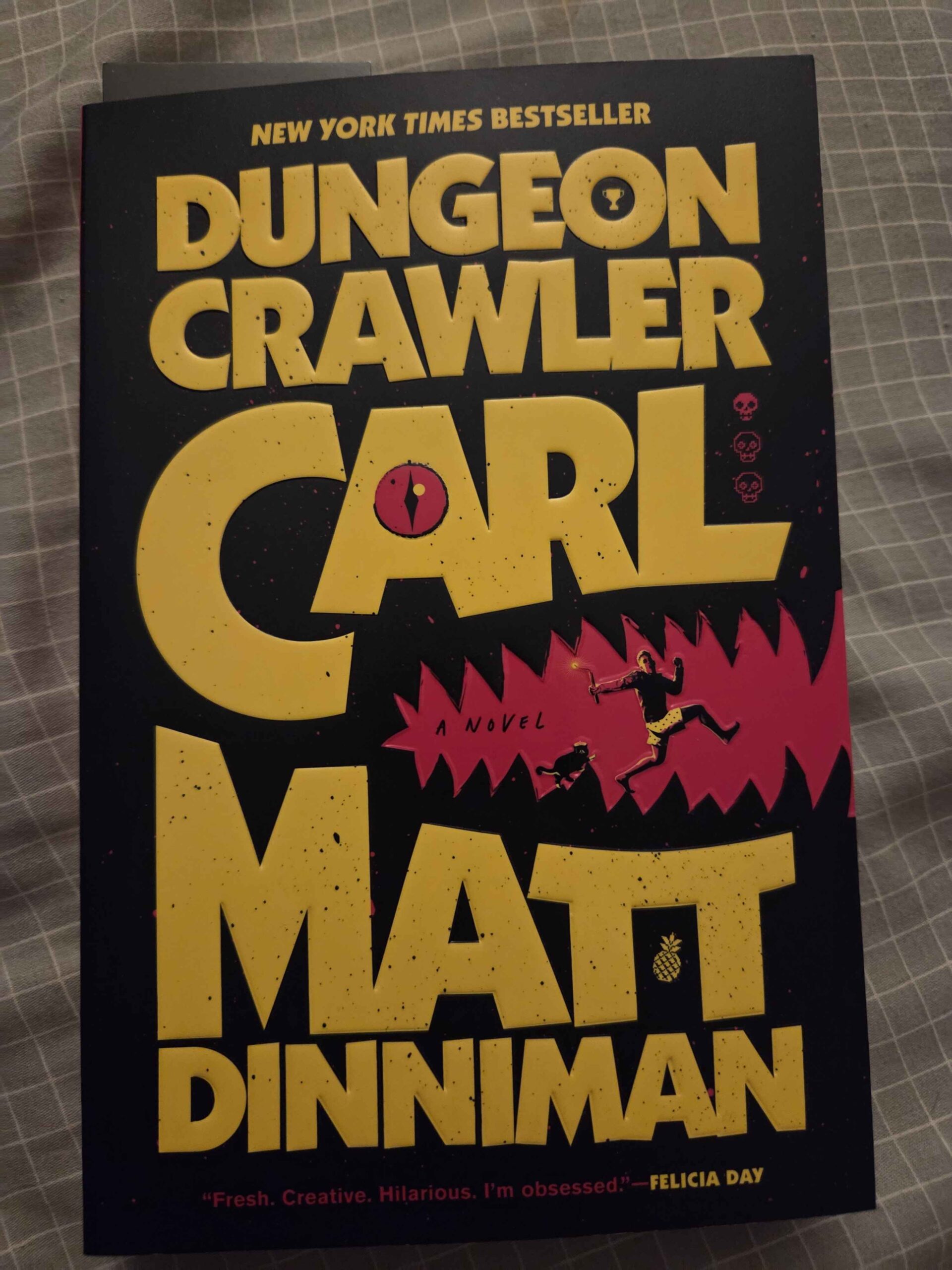
  • Dungeon Crawler Carl is Pretty Dang Good, But Not Great

    Dungeon Crawler Carl is Pretty Dang Good, But Not Great

    (This blog post contains slight spoilers for Dungeon Crawler Carl Book 1.)

    It feels like the popularity of this series came out of nowhere and completely blindsided me. Sure, I’d seen the book advertised numerous times at a Barnes and Noble many times, and I even picked it up and read the blurb on the back. “This seems decent.” I remember thinking to myself, and promptly put it back on the display.

    A couple weeks ago, a Discord group I’m in just out of nowhere brought it up. Suddenly half the group was talking about how they’re all completely obsessed with this series and started sharing fan art and talking about how obsessed they were with it and all these things. I swear to you, no one I knew even knew this existed, so it seemed really bizarre to me for this to just happen. I even asked another friend of mine who loves reading more than me about it and he told me the same thing how the obsession from everyone seemed to come out of nowhere. He also had a friend beg him to read it and they entered a “trade” where he’d read it if his friend in turn read something he chose.

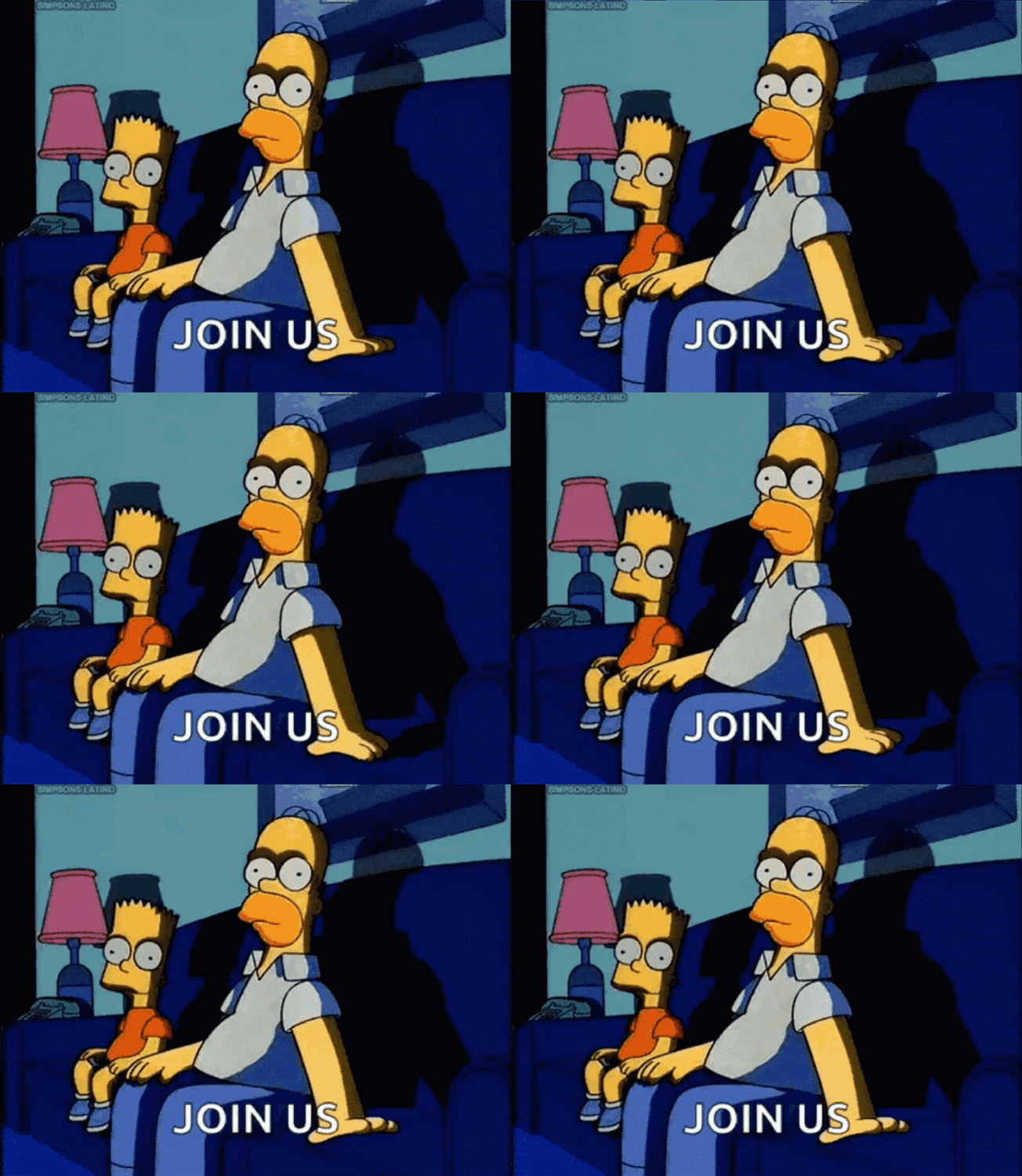
    I mentioned to the group that I’d seen it advertised a lot and I thought it seemed neat. Suddenly I got most of the group jumping up and down (Or, well, they were in my mind. We’re in a Discord group so it’s not like I could see them. Work with me on this okay?) and telling me I absolutely should, one of them even posting a Simpsons “Join ussss” gif.

    Being told to read this book and then buying it almost made me feel like I was joining a cult with the level of excitement there was about it. Okay that’s a huge over-exaggeration, but still!

    The next time my fiance and I were out, I decided I was gonna bite the bullet and try it. At this point I was kind of apprehensive about it because I had really high expectations, which I hate approaching anything with, as it clouds my ability to enjoy it in a lot of cases. Like when everyone talks up something about how great it is, there’s like an expectation that you have to enjoy it, and if you don’t, telling them you didn’t makes you feel like you’re disappointing them, or that you feel like you missed something, even though you just…didn’t enjoy it the way they did. It’s irrational, and you know that, but you just can’t shake it once it takes hold.

    When we walked into the Half-Price Books, it was like the universe was aware of what I was doing, because smack in the center aisle, facing the front door, Dungeon Crawler Carl sat, staring at me and my fiance. We went to the stand and my fiance (smartly) told me to grab one of the ones under the pile since the one on display probably gets touched and picked up and messed with the most since it’s the one at the front. I finished up Redwall (The first book, Redwall, not the entire series. You know what I mean.) and immediately leaped into this book, expectations high.

    Dungeon Crawler Carl is pretty dang good.

    I told a friend I was reading this and was going to read Dungeon Crawler Carl after this and was informed it was going to be like whiplash. They weren’t kidding. Also, this book holds up extremely well and I’m glad to finally read it now that I’m older and not a dorky little preteen.

    The story revolves around Carl and his ex-girlfriend’s cat Princess Donut, as the world around them unexpectedly falls to ruin in the blink of an eye. They see a staircase materialize and choose to descend it, unbeknownst to them entering a dungeon where the entire galaxy will watch them try to fight and survive.

    Matt Dinniman, the author, does a fantastic job with the setup and the pacing. Throughout the entire book, he manages to keep it interesting and pretty fast paced. The opening prologue doesn’t take long before the action starts, and you’re fed the information you need to know, while little bits and pieces of Carl’s backstory and such are scattered through the rest of the book at proper moments.

    Just as the main characters are hurled through the story, so too is the reader, but Dinniman does an excellent job choosing the proper moments for when to slow down and explain things through other characters. While it can be somewhat overwhelming, it also helps if you understand the basic concepts of Tabletop Role-Playing Game or video game mechanics, as this book doesn’t shy away from jargon used in those. The intended audience seems to be those in the “nerd” culture, but even if you don’t know the terminology and such, there’s enough context clues and enough is explained that I think even someone without prior knowledge will understand what’s being said.

    As I started to read more of the story, I realized that the format of it is less Dungeons and Dragons and more Sword Art Online. Sure, the mechanics and races and all of that are D&D, but the concept of the dungeon seems almost entirely in parallel to Sword Art Online. In the book, the objective is to level up and reach the final floor to secure your freedom in order to escape the dungeon. Sword Art Online is in the same vein where characters are trapped in a virtual video game and the only way to escape is for someone to clear the top floor of that games dungeon, while death in the game means dying in real life.

    To be clear, there’s absolutely nothing wrong with this comparison at all; it’s more of an observation. Lots and lots of works are in many ways derivative of other things, and it would only be a problem if it were a one-to-one copy, but it very clearly isn’t. As long as they’re doing something unique with the idea, then in my opinion, it’s perfectly fine. I also think the same thing applies to tropes as well. I don’t care if a trope is used, I care about how it’s used. There’s a major difference, and in reality, it’s almost impossible to avoid using a trope in some form anyway.

    I’ve only seen the anime and never read the light novels, but I imagine they’re relatively similar. I bet the novels are better though; they usually are.

    With all of this said, you might notice I said the book is just “pretty dang” good. While that’s kinda vague, I had one major hangup with the story that is also a major part of it.

    I’m really mixed about the humor in the book.

    Leaning into its absurd premise, the novel also leans heavily into its humor, going out of its way to crack jokes almost every page. The humor is…well…I don’t know what you’d call it, but the only thing I can think to call it is “stupid humor”. in addition to the absurd premise, the novel has things such as fire breathing llamas that also carry meth on them, goblins who then go on a “drug war” against the llamas because they want the meth, and so forth. Essentially, it feels like something a 14 or 15 year old might come up with and write, and while it’s explained in the story about the aliens grossly misunderstanding the Earth and its culture, it’s…still humor that seems like it was written by a 14 or 15 year old.

    There’s also an AI in the book who writes descriptions for items the characters pick up and almost every single time, I just rolled my eyes at them. Funnily enough, that’s supposed to be the point, and Carl even comments on this a few times, but at the same time it feels like it’s supposed to be funny for the sake of the reader, which means that even though it has precedence in the world, it’s still written with an almost meta intention, so even with the justification, I still groaned at almost every single one. A lot of the humor and writing also leans very heavily on references to real world media, with shows such as Cops or Judge Judy getting a mention. There’s even a few YouTube videos mentioned as well, and while this is probably a result of this book being extremely modern, the mentioning of these felt a bit weird to me. Humor like this only lands if you know the reference, and if you don’t you just kinda go, “…Huh?” It reminded me of the main problem I had with the Super Mario Galaxy Movie of all things.

    At its absolute worst, the humor is insulting, and there were a couple of special needs jokes that I absolutely didn’t appreciate. Those jokes are never funny, full stop. I had to put the book down for a second after reading one of them and it admittedly soured the book for me for a while, worried that it was going to be like that the whole time. Having grown up as a special needs kid, it’s especially frustrating because I already got put through that whole ringer in school, and seeing it continue to happen even out of school, it’s pretty frustrating. I guess some people, even those with special needs, can look past or maybe even laugh at it, but I’m not one of those people.

    Thankfully, it only happened the one time and while there was another similar, though less egregious, joke, it stopped after that. That’s the sort of fine line this humor has straddle, and ultimately, your enjoyment of this book is going to come down to how much you like this humor or at the very least tolerate it. Personally, I tolerated and pushed towards it because when Dinniman isn’t making jokes or references, the story is really engaging, and the characters are (mostly) charming and I look forward to seeing what they do or say next. Dinniman does an excellent job of setting stakes, and then releasing the tension, while also setting the stakes even higher the next time. He also does a lot of setup and world-building, which makes the idea of the next books even more exciting.

    This is why I stuck to it and despite my frustrations found this a fun read. The premise makes it so that the further along the story goes because of the inherent danger of going deeper in the dungeon, the more expectations there are of what can happen. Because Dinniman makes the events of what happen on these early floors so intense, it means the later floors in the later books must be even more nuanced or exciting. Dinniman, despite the absurdity, is also oozing with creativity in this story, and it’s that creativity that had me hooked.

    Dinniman also smartly doesn’t just make the story a straightforward one about survival; there’s a lot of things happening on the side, and those events directly affect the main characters, who are drip fed information and are left to speculation as to what things mean. This approach works well because it allows for anything to happen, and since the book is told purely in first person from Carl’s POV, what he learns is what we learn, and this decision to make it this perspective is smartly done.

    That’s what makes this so frustrating though, is that this book IS smartly done. It’s just covered in a layer of humor that I generally don’t agree with or enjoy. While writing this, I realized that this book is a common storytelling method used especially in modern times. There’s a story that is ultimately supposed to be a serious tale with themes and symbolism, but it’s also wrapped in a huge layer of humor. One popular example I can think of in regards to this is the game Undertale. That game is rife with silly humor at just about every turn, but underneath all of it is a story and characters with very real and very serious themes and emotions. While I enjoyed Undertale and its humor, I wonder if in some ways someone might feel the way about Undertale the same way I do about Dungeon Crawler Carl, where they find the underlying themes and characters endearing, but the humor is an annoyance. I suppose the opposite could also be true where people only view Undertale as a humorous game, but found the serious elements distracting or annoying.

    Weren’t expecting Undertale to get mentioned here, huh? Actually I kinda wasn’t either.

    This dichotomy of silly and serious meshed into one is also what makes it extremely hard to write for. If one element is more noted than the other, it can undermine the other element entirely. And if people are just going to favor one element over the other, it could be asked then what the point is of even having the other element at all. In addition, humor is probably one of the most subjective tastes out there, so it’s even more difficult to get something like this right. There’s a dangerous level as well where a serious scene might be completely ruined by an ill-timed joke as well, or even the opposite where characters are joking around and someone drops a serious topic out of nowhere. When handled poorly, this kind of thing can create an emotional whiplash, making you wonder how you’re supposed to feel, and at the worst of it, making light of topics for the sake of a joke that really shouldn’t be joked about at all.

    But based on the popularity of this series, clearly he did something right for a lot of people. After reading this, I could see why it’s as popular and loved as much as it is. It feels like it was written by someone who grew up with internet culture and internet humor. A lot of modern young adults especially also grew up with this same culture, so it resonates heavily with them. This is not something someone over a certain age would enjoy, and it feels directly aimed at that audience beyond the RPG jargon and such.

    Despite all of that, there were a few times the humor was genuinely funny, and the absurdity with the creativity made for a lot of amusing ideas. It’s just the underlying descriptions and unnecessarily crude additions such as lots of sex jokes or drugs were way too much and too frequent.

    I’ve spent a lot of time talking about this hang up I have about the book, because at the end of the day, I really liked this book. The criticism I have with the humor is made more profound to me because of how much I ended up enjoying it. I was a bit hesitant to learn there’s already eight books in this series, despite the first one being published in 2020, but I’ve been reassured from fans that the story only gets better as it goes on, so I am generally excited to start the next one.

    Glurp glurp!

  • Hypercriticality is the Death of Enjoyment

    Hypercriticality is the Death of Enjoyment


    The first ever Dynasty Warriors game, otherwise called Musou games, I played was Dynasty Warriors 4. These games are really simple in premise: You play as a warrior who is capable of mowing down tons and tons of enemies using simple button combos, and they don’t usually put up much of a threat, if at all in most cases. There are stronger generals to fight of course, and they put up much more of a challenge, but on the whole these games aren’t super challenging until you go into their harder difficulties or you try to fight Lu Bu unprepared. IYKYK.


    Naturally, these games get panned online, especially in the critic scene. “All you do is mash square.” “What’s the point of the peon enemies if they don’t do anything?” “These games are stupid repetitive.” and on and on. Not to mention that back then, they made a new one every year or so, some of them being the same game but expansions instead. They were ultimately niche and it felt hard to talk about them online for a while because the conversation always circulated in that same manner. In retrospect, I probably should’ve just went to a fansite with a forum or something to talk about them, but I didn’t and instead went to general forums instead, so a lot of the time it was all negative. It also became incredibly funny to me a few years later when Call of Duty kept releasing yearly games that were all the same thing and they’d be praised as individual masterpieces despite being copy and pastes that people chose to see the nuance in, but no one would do the same for Dynasty Warriors.

    Admit it, you tried to fight this guy the first time you played one of these games because you thought they were relatively simple games and he completely trounced you.


    I love these games precisely because of that level of simplicity. It’s fun to just run into a group and plow through mobs with crazy over the top moves. It’s satisfying watching that KO count grow, and using combos you know for proper crowd clearing. It’s fun to fight the generals and have to pivot to a touch more strategy (though admittedly not much strategy) and get a reward of a stat boost or a new weapon to make your character stronger. There were always lots of characters to play as too with unique movesets and such and it was just a fun game to plop in when I didn’t want something incredibly taxing and I just wanted some simple, raw fun.


    After a while, the hate for it died out and Omega Force kept making more of them anyways because no matter what the haters said, people loved these games and bought them, so they made them for their audience. Surprisingly, the opinion of these games went up over time and some of them got decent scores like Dynasty Warriors 8.


    But then in 2014, something that to this day I still cannot believe happened, and we got a game called Hyrule Warriors.

    If you told me we’d be getting a Zelda Musou game back in 2004 I’d have called you crazy.


    The moment I laid eyes on this I felt two different things: The Zelda fans are going to play this game and tear it to microscopic fucking shreds, and I’m going to love every second I play of this game. I was correct on both accounts. Just as quickly as the Musou complaining had left the internet sphere, it quickly resurfaced because people were going to buy this game because it had “Zelda” in the title, so it was already a guaranteed million seller. Which it of course did and simultaneously became the best selling Musou game at the time because all you have to do is slap Zelda into something and it’ll sell no matter what it is, just like Mario and Pokemon.


    Yet again I wanted to be excited and talk about the game, but yet again, I was met with constant snark and negativity about the same tired complaints people had been saying about a game style that I loved. This game had the added benefit of having an original story in a franchise where the fans are never satisfied no matter how the stories are written, so it naturally got labeled as “just being fan-fiction” or my favorite one, “It’s not canon and not on the timeline so it’s irrelevant.”


    This is a lot of rambling, but all of this is because there’s a point I want to make with all of it, and that’s hypercriticality. I might have used musou games as a main point here, but when you really stop and think about or just look, people value hypercriticality to a massive degree. On the internet, snark and criticism is king. If you admit to liking something despite its faults, then you’re nothing more than a blind fan or someone who has no taste. Your opinion to them holds no weight because we’ve equated liking something to either complacency or you just didn’t examine it hard enough. I’ve noticed in many conversations online how the person who talks the most critically is always the one people value because it makes them appear to be the most well-thought out; after all, they’re critical so they MUST know what they’re talking about, right?


    The problem with this approach comes when you suddenly ask someone who just spent all that time listing off things they didn’t like what they DID like, and they often struggle to do so. Someone whose entire purpose is to be eternally critical is by default biased, and in my eyes, it’s hard to take what they’re saying as valuable, because in order for something to have a bad quality, there must be a good quality for it to have a counter to. The main problem though, is that people have forgotten how to just enjoy things. We constantly have our guard up, ready to pounce and trounce on something without giving it a chance. We read negative reviews of things we barely look into and say, “That game got a bad review? Sucks to suck, LOL.” and move on without any consideration even if we were potentially interested in it.

    The Another Code games received kinda middling reviews but the first game especially is one of the best visual novels I’ve ever played.


    You ever see a YouTube video or read a post by someone where they’re super nostalgic for the old days when they were kids and how games were better then and all that jazz? The thing is, I don’t think people want games to be like that again when they say things like “Games were better then!” I think more of what they’re saying is they want to be young again so they can enjoy things again. God knows the number of groups I’ve hung out with of people who love retro games and yet at every opportunity complain about retro games being janky or bad or whatever, completely contradicting themselves. This phenomenon exists because people don’t remember how to enjoy things for what they are. We’re adults now and we’ve been through the ringer and had our lives ruined in 10 different ways and in 5 different languages, so we know the way of the world and what’s good and what isn’t. It’s hard to remove that mask once you put it on because it’s what you know and how you survive.


    But if you can learn to remove that mask to just enjoy something, you start to find more and more that there’s still lots of things to find happiness in, to see how things could be viewed as fun to other people, or even appreciate the absurdity of something for the sake of what it is rather than question the reason for its existence. I don’t really like rap music or sports games for example, but I still understand why people like them and appreciate them for what they are even if I don’t personally enjoy it, and I think that makes a huge difference.


    Hypercriticality also exists because it feels like that’s what you have to do to feel socially included in this circle. No matter how much people will decry it, humans are social creatures by nature, and even the “weird” ones still have to have some form of socialization, and if the common thing of acceptance for a topic leans into one idea, then that’s what everyone is going to lean towards. Choosing to defy that makes you an outcast and as a result you’re looked down upon which, as a human, is not something your brain wants to have happen usually. But it’s funny then that in this instance, the common ground of what is acceptable in this bubble is itself defeatist because of excess. And in this instance, I think it’s best to decry it.

    Parasite Eve 2 is one of my favorite games of all time. I appreciate it for what it is as opposed to comparing it to the first game, which is really different.


    I want to make something perfectly clear: I’m not saying you should never criticize anything or that it’s not okay to ever be critical. The problem isn’t that people are sometimes critical, it’s that people are critical so much and so often about every element that they’ve forgotten to sometimes just enjoy themselves and as a result, they lose touch with why they even like the hobby to begin with. After all, if someone asks you if you like Zelda and you say it’s your favorite series yet all you do is complain about every single thing about it, do you really enjoy it at all? I wouldn’t blame the person who asked you what you liked if they assumed you didn’t like it.


    I also want to make it clear that I’m not saying you have to love everything either. Sometimes you just don’t vibe with a game or movie or whatever and that’s perfectly fine. I played Crimson Desert and tried desperately to like it but I simply couldn’t, and finally had to put it down and accept it wasn’t for me and that I disagreed with a lot of the mechanics and such. Sometimes that’s just how it goes, but I also wasn’t trying to be hypercritical of it either.


    I used to write for a couple websites as a columns writer and then as a video game soundtrack reviewer, and I used to think to myself that one day I’d like to be a writer for a website or maybe do game reviews, but the more I wrote and the more I spoke to people and saw what people wrote, I started to realize that being a reviewer would require me to strip away gleaning enjoyment out of a thing because I wasn’t playing a game because I wanted to: I was playing a game because I was on a tight deadline and I had to churn something out for the sake of a job. I’ve often wondered how many reviewers are exactly like this, where they have to suffer through a game just so they can spit something out for their job, even if their job is about informing the player of whether or not they should play something. If I had to do that all the time for my day job, I think I’d just hate video games and I’d want to drop the hobby entirely.

    Fun fact, my playthrough of Crimson Desert was what inspired me to even make a website and write stuff here. Maybe I’ll write down my extended thoughts on this game someday.


    For me, I try to enjoy things as much as I can. I realized one day while I was playing a game that I genuinely wasn’t having fun with anything, because I started to realize that all I was doing was complaining about everything in every game. I’d forgotten how to just enjoy something, and even old games I liked I would just grumble at because I spent so much time criticizing them that I was robbing all the fun out of them by utilizing what I had thought and were told were objective criticisms. But when I thought about it more I came to a realization.


    No matter how hard we try to be and how hard we try to hide it, humans are not rational creatures.


    Do I know every single flaw in a Musou game? Yup. Do I recognize that they’re repetitive and you can mash square and occasionally triangle and win? Absolutely. Do I know that they’re massive grindfests where you play a lot of the same stage over and over and they’re all about “number go up” and are practically skinnerboxes? You bet I do.


    And yet I don’t care because these games are still fucking fun to me, and that’s all that matters.


    You can shove all the logic and reasoning onto why I should hate these games and even if there’s solid reasoning behind it, I don’t give a flying fuck, I find it fun, I find it enjoyable, and that’s the end of it. If I listened to all the hypercriticality and bluster people made about games, I seriously doubt I’d have found even half the games I played and enjoyed, just because everyone screamed “STAY AWAY IT’S BAD.” I remember reading a review for Tales of the Abyss in an old Game Informer once and that they gave it a 7 out of 10 and said it was a boring, bog standard JRPG. I ignored that review and bought it and Tales of the Abyss is still one of my favorite Tales games despite its shortcomings. I liked it so much I played through it twice almost back to back despite it being a 60 hour RPG. I would’ve completely missed it if I’d listened to reason or logic.

    Tales of the Abyss got middling reviews and was considered a “typical JRPG” but I ignored those reviews and found a lot to love in all the aspects of this game, from the characters to the gameplay.


    I think now more than ever it’s important to learn how to remove the hypercritical mask. At this time of writing, not just the games industry, but the world is dealing with unprecedented times, and learning to find the joy in things is even more important than its ever been. I know for me that I have to do that, because otherwise I’ll just give up entirely on video games, and I’ve come damn close multiple times. More than anything though, being able to enjoy things brings me happiness in some form. If we stop looking at something for what it isn’t or what we wish it was and instead look at it for what it is, I bet we’d find a lot more to love from it than we’d realize. That kind of thing takes a lot of mental strength, especially in this day and age and especially as adults, but I can only imagine how much better off in our lives and how much happiness we’d find if we could all learn to do that more often.